<?xml version="1.0" encoding="UTF-8"?>
<?xml-stylesheet type="text/xsl" href="/stylesheets/feed.atom.xml" media="screen"?>
<feed xml:lang="en-US" xmlns="http://www.w3.org/2005/Atom">
  <id>tag:weareall.nd.edu,2005:/our-stories/news</id>
  <link rel="alternate" type="text/html" href="https://weareall.nd.edu"/>
  <link rel="self" type="application/atom+xml" href="https://weareall.nd.edu/our-stories/news.atom"/>
  <id>tag:weareall.nd.edu,2005:/latest</id>
  <title>We Are All Notre Dame | Stories</title>
  <updated>2026-08-11T12:29:00-04:00</updated>
  <link rel="alternate" type="text/html" href="https://weareall.nd.edu/"/>
  <link rel="self" type="application/atom+xml" href="https://weareall.nd.edu//our-stories/news.atom"/>
  <subtitle>The University of Notre Dame is a Catholic research university upholding human dignity, promoting social justice, and serving the vulnerable.</subtitle>
  <entry>
    <id>tag:weareall.nd.edu,2005:News/184663</id>
    <published>2026-08-11T12:29:00-04:00</published>
    <updated>2026-08-11T12:30:16-04:00</updated>
    <link rel="alternate" type="text/html" href="https://weareall.nd.edu/our-stories/news/the-one-thing-you-should-know-about-notre-dame-dublin/"/>
    <title>The one thing you should know about Notre Dame Dublin</title>
    <summary type="text">
      <![CDATA[…]]>
    </summary>
    <content type="html">
      <![CDATA[<figure class="image image-default"><img src="https://global.nd.edu/assets/651794/950x/the_one_thing_graphic_1200_x_400_px_3_.webp" alt='Text: "[the] ONE THING" on a dark blue world map. "the" is golden and bracketed; "ONE THING" is large, white.' width="950" height="317"></figure>
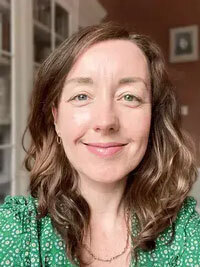
<figure class="image image-right"><img src="https://global.nd.edu/assets/672475/1_ecdelany_2.jpg" alt="Smiling woman with wavy brown hair, one blue eye and one green eye, wearing a green patterned top." width="200" height="267">
<figcaption>Eimear Clowry Delaney, Michael J. Smurfit Director of Notre Dame Dublin</figcaption>
</figure>
<p><em>This story is part of Notre Dame Global's series titled "<a href="https://global.nd.edu/news-stories/news/notre-dame-globals-the-one-thing-series-featuring-the-universitys-twelve-global-locations/">The One Thing.</a>"</em></p>
<p>In 2026, we are taking a new look at Notre Dame’s 12 global locations by asking each of their directors one question: “What is the one thing you would like the Notre Dame community to know about your programs, your achievements, your goals, or your aspirations?”</p>
<p>We focus now on <a href="https://dublin.nd.edu/">Notre Dame Dublin</a>, headed since 2024 by <a href="https://global.nd.edu/about/people/eimear-clowry/">Eimear Clowry Delaney</a>, Michael J. Smurfit Director, who joined the Keough Naughton Notre Dame Centre in 2008 and previously served as its senior associate director.</p>
<hr>
<h3>What is the one thing you want the Notre Dame community to know about Notre Dame Dublin?</h3>
<blockquote>
<p>“Student learning and teaching are at the core of everything we do.”</p>
</blockquote>
<p><strong>EIMEAR CLOWRY DELANEY:</strong> Notre Dame Dublin was founded in 1998—nearly 30 years ago. That is our origin story—we began as a student center, a learning center in Dublin. All of our current programs and collaborations spring from that history.</p>
<figure class="image image-right"><img src="https://global.nd.edu/assets/666283/450x/2_mc_824.jpg" alt="Blue door of the Notre Dame Centre in Dublin, adorned with blue and yellow flowers, and a green ND logo carpet." width="450" height="299">
<figcaption>Front door of O’Connell House in Dublin, Ireland</figcaption>
</figure>
<p>Since the center’s founding, the Notre Dame students who come to Dublin have been the pathfinders in Ireland for the University as a whole and for its many collaborations with Irish society more broadly. The fifty or so undergraduates who come to us each semester for a study-abroad experience attend classes—and are fully immersed—in one of three universities: Dublin City University, Trinity College Dublin, or University College Dublin. And, when one of us at O’Connell House encounters a potential partner or collaborator, if they've had an experience with our students, they are more than willing to engage with us. They trust us based on the experience that they've had with our young people already—whether through one of the three universities or through one of our many internship placements during the semester or summer—at the National Gallery of Art or the Department of Foreign Affairs, for instance.</p>
<p>A beautiful, organic respect has been built for Notre Dame as an institution through these outstanding young people, from their desire to be in Ireland, their curiosity for the island they inhabit, and for their work during the time that they're with us.</p>
<hr>
<h3>Why is that one thing—that student learning and teaching are at the core of everything you do—so important to Notre Dame Dublin?</h3>
<blockquote>
<p>“Making student learning and teaching central is how we engage with the purpose of a university—to educate and to inspire brilliant young minds to not only transform the world, but to transform how they <em>see</em> the world, how they <em>feel</em> in the world, and how they want to <em>be</em> in the world in the future.”</p>
</blockquote>
<p><strong>EIMEAR CLOWRY DELANEY:</strong> Our students come to us with ambition, curiosity, drive, creativity, and diverging opinions. That makes them brave, and these qualities make us brave, too.</p>
<p>Related to that bravery, one thing I am passionate about is that a part of studying abroad, researching abroad, and learning abroad is getting lost. If a program is too prescriptive, students aren’t able to see that while Ireland is an ancient island, we are also very advanced in today’s world. That can surprise some young people—but that can only happen if they are given the opportunity to explore, to get lost a bit, and go farther and deeper than one does with a typical tourist experience.</p>
<figure class="image image-right"><img src="https://global.nd.edu/assets/666298/450x/3_img_6847.jpg" alt="Man in grey sweater and pom-pom hat holds an orange W. B. Yeats book, speaking to students on a rocky hill." width="450" height="300">
<figcaption>Professor Kevin Whelan teaches the poetry of W.B. Yeats as the students sit atop Knocknarea, County Sligo, on what is said to be ancient Celtic warrior goddess Queen Medb's Cairn, a 5,000-year-old neolithic passage tomb. The culture, landscape, and folklore in this area of Sligo, now known as "Yeats Country," was hugely influential to W.B. Yeats.</figcaption>
</figure>
<p>For that reason, here at Notre Dame Dublin, our core focus is building community, learning, and growing together through, as we say, “the soles of our feet.”</p>
<p>Our motto is <em>Is ar scáth a chéile a mhaireann na daoine</em>, an Irish proverb that translates to "People live in the shelter of each other,” reflecting our interconnectedness and reliance on community to survive and thrive.</p>
<p>The hundreds of students who have embraced this way of study abroad are a testimony to its effectiveness. One such student is <strong>Meera Baakta ‘26</strong>, who says, “In Dublin, I was able to explore questions similar to those across science and development that I studied at Notre Dame’s home campus, but within a different intellectual and social ecosystem. Connecting with professors and peers across courses such as Trinity College Dublin’s EthicsLab, I was able to expand my understanding of complex dilemmas and enrich my experience by learning alongside people formed by different histories and perspectives. I also began to learn the Irish language in classes at O’Connell House, and then continued my studies back on campus.” <a href="#meera">See Meera's story below</a></p>
<hr>
<p><strong> </strong></p>
<h3>What does that one thing reveal about Notre Dame Dublin and Ireland overall?</h3>
<blockquote>
<p>“We Irish are a curious people, an island of people within a very small land mass who live in close proximity to each other. We build strong relationships within our own, sometimes parochial, communities. But we thrive in getting to know new people, and that curiosity—of wanting to interrogate, discuss, converse, or debate with others—is a very strong part of Irish culture.”</p>
</blockquote>
<p><strong>EIMEAR CLOWRY DELANEY:</strong> This quality of curiosity about how others think is at the core of who we are as a people. And, to be able to bring new people into the fold who may not think the same, that in itself is very Irish.</p>
<p>Curiosity works both ways. A key opportunity with international education is to understand that, wherever they claim citizenry, people are not really that different. The challenges we face are very much shared. With that realization comes a desire to problem-solve together. So, as a little island on the periphery of the Atlantic and of Europe, we Irish have traditionally felt rather isolated and alone. But now, Ireland has taken on a new identity—one of being a changemaker. We have a tiny population, but we have a very significant voice in the world. We will flourish and thrive only if we share that with the world and invite and welcome other people to be with us.</p>
<figure class="image image-right"><img src="https://global.nd.edu/assets/666303/450x/4_panel_discussion.jpg" alt="Two women, one gesturing, lead a panel on Michael Cronin's &quot;Translating Ireland&quot; at Notre Dame Dublin for an audience." width="450" height="300">
<figcaption>As part of the Translating Ireland Conference, University of Notre Dame professor Clíona Ní Ríordáin chaired the "Translating Irish Literature out of Ireland" panel discussion, which featured translators Marco Sonzogni (Victoria University, New Zealand), Marie Hermet (France), and Indrek Õis (Estonia).</figcaption>
</figure>
<p>Interrogating how Ireland has been a changemaker was one of the subjects of the <a href="https://global.nd.edu/news-events/events/2026/04/16/377367-translating-ireland-symposium/">“Translating Ireland” symposium</a> Notre Dame Dublin hosted with several partners this past April to mark the 30th anniversary of the publication of the influential book by Michael Cronin, Translating Ireland. Led by <a href="https://irishlanguage.nd.edu/people/cliona-ni-riordain/">Clíona Ní Ríordáin</a>, the Thomas J. and Kathleen M. O’Donnell Chair in Irish Language and Literature, participants explored the central role translation played in the contact zone between languages as well as how it shaped the development of the languages of literature and the construction of identity in Ireland.</p>
<p>Looking ahead, I am very excited about an upcoming partnership within the University’s <a href="https://strategicframework.nd.edu/initiatives/arts/">Arts Initiative</a> between Notre Dame Dublin and <a href="https://mexico.nd.edu/">Notre Dame Mexico</a>. We are excited to make a joint announcement in August that will include all the details.</p>
<p><strong>Learn more about the work of <a href="https://dublin.nd.edu/">Notre Dame Dublin</a> and the University of Notre Dame’s <a href="https://global.nd.edu/global-network/">global network</a>, or browse related articles:</strong></p>
<ul>
<li><a href="https://dublin.nd.edu/news-stories/news/daniel-oconnell-the-emancipator-documentary-launched-by-notre-dame-dublin/">Daniel O’Connell: The Emancipator Documentary Launched by Notre Dame Dublin</a></li>
<li><a href="https://dublin.nd.edu/news-stories/news/clare-cullinan-named-valedictorian-bennett-schmitt-selected-as-salutatorian-for-the-class-of-2025/">2026 Valedictorian and Salutatorian both studied in Dublin </a></li>
<li><a href="https://global.nd.edu/news-events/events/2026/04/16/377367-translating-ireland-symposium/">With several partners, including Notre Dame Dublin, Professor Clíona Ní Ríordáin co-organizes a symposium to mark the 30th anniversary of the publication of the influential book Translating Ireland by Michael Cronin</a></li>
<li><a href="https://dublin.nd.edu/news-stories/news/notre-dame-dublin-students-explore-the-european-pilgrimage-tradition/">Notre Dame Dublin students explore the European pilgrimage tradition</a></li>
<li><a href="https://dublin.nd.edu/news-stories/news/notre-dame-students-embrace-community-engaged-learning-in-ireland/">Notre Dame students embrace community-engaged learning in Ireland</a></li>
<li><a href="https://dublin.nd.edu/news-stories/news/notre-dame-dublin-supports-four-nanovic-sustainability-research-fellows/">Notre Dame Dublin supports four Nanovic sustainability fellows</a></li>
<li><a href="https://stories.nd.edu/stories/ireland-series/a-bogs-life/">Mariana Silva ND ’21 and Trinity College Dublin graduate student studies a bog’s life and why preserving Ireland’s bogs is so important</a></li>
</ul>
<hr>
<h2>Learn more about the collaborative work and partners of Notre Dame Dublin</h2>
<hr>
<h2>The Legacy of Daniel O’Connell</h2>
<figure class="image image-default"><img src="https://global.nd.edu/assets/666305/1000x/danieloconnell_riam_32_cropped.jpg" alt="Four people smile. Left to right: man with beard/glasses, woman in green, man in suit, man with curly hair. ND Golden Dome.">
<figcaption>Eimear Clowry Delaney, Michael J. Smurfit Director of Notre Dame Dublin, attends the <em>Daniel O’Connell: The Emancipator</em> documentary premiere alongside (left to right) the documentary director Ruán Magan, University of Notre Dame Vice President &amp; Associate Provost Michael Pippenger, and composer and musician Colm Mac Con Iomaire.</figcaption>
</figure>
<p>The Keough Naughton Notre Dame Centre at O’Connell House is the home of Notre Dame Dublin. Located at Number 58, Merrion Square, the centre was once home to the celebrated early nineteenth-century Irish Catholic political leader Daniel O’Connell.</p>
<p>O’Connell is the subject of <a href="https://dublin.nd.edu/news-stories/news/daniel-oconnell-the-emancipator-documentary-launched-by-notre-dame-dublin/">a documentary</a> titled <em>Daniel O’Connell: The Emancipator</em>, produced by Create One in association with Notre Dame, University College Cork, and RTÉ, Ireland’s national television and radio broadcaster.</p>
<p>The documentary traces O’Connell’s journey from Kerry lawyer to global advocate for justice. Known as “The Liberator,” he secured Catholic Emancipation, pioneered non-violent mass political mobilization, and inspired democratic movements around the world.</p>
<p>The release of <em>Daniel O’Connell: The Emancipator</em> will form part of a four-year-long program of commemorations and research, from O’Connell’s 250th birthday in 2025 to the 200th anniversary of Catholic Emancipation in 2029, inviting audiences to reflect on how his vision for justice and democracy continues to shape our world.</p>
<p>The <a href="https://dublin.nd.edu/events/2025/11/25/gala-premiere-of-new-documentary-daniel-oconnell-the-emancipator/">gala premiere </a>of the documentary was held in Dublin in November 2025.</p>
<p>There will be a screening of The Emancipator on the Notre Dame campus Friday, November 13th, at the DeBartolo Performing Arts Center, and another screening at the Chicago Consulate Film Festival on Sunday, November 15th.<a id="meera"></a></p>
<hr>
<p><strong> </strong></p>
<h2>More Than a Semester Abroad</h2>
<figure class="image image-right"><img src="https://global.nd.edu/assets/666307/350x/6_meera_b_cropped.jpg" alt="Meera Bhakta. Smiling woman in black sleeveless top with red/gold stripes and jeans, stands by colorful flowers and ornate stone building.">
<figcaption>Meera Bhakta, ‘26</figcaption>
</figure>
<p><em><strong>Meera Bhakta ‘26</strong> graduated with a major in science preprofessional studies and a minor in international development. During the spring 2025 semester, she studied at Trinity College Dublin and will return to Trinity this fall as a Naughton Fellow pursuing a masters of science degree in translational oncology.</em></p>
<p>For my study abroad experience at Notre Dame, I explored programs from Santiago to Copenhagen, hoping there would be a clear sign pointing me in one direction. Eventually, I chose Trinity College Dublin because it allowed me to take a wide range of courses I was interested in and would allow me to fully integrate into a host university. At the time, I had researched Trinity extensively, but I knew relatively little about Ireland itself. Looking back, that is part of what made the experience so impactful. By not knowing, I was open to the surprises Ireland had in store for me. <br><br>In Dublin, I was able to explore questions similar to those I studied at Notre Dame across science and development, but within a different intellectual and social ecosystem. Connecting with professors and peers across courses such as EthicsLab, I was able to expand my understanding of complex dilemmas and enrich my experience by learning alongside people formed by different histories and perspectives.</p>
<p>Beyond the classroom, Dublin also impacted me through the people and communities I engaged with. Every Tuesday, I volunteered with an after-school program at St. Catherine’s Church through the Solas project. Some afternoons were spent helping with homework, others playing outside, organizing holiday activities, or sharing stories. Those Tuesdays filled my semester with an unexpected source of laughter and friendship, and taught me about allowing myself to be shaped by the people around me.</p>
<p><strong> </strong></p>
<p>O’Connell House also became a valuable home base throughout the semester, providing a place for conversations, reunions with friends studying across the city, tea and digestive breaks, and opportunities to learn more about the Irish language, history, and culture. I began studying Irish through classes there, and then continued my studies back on campus.</p>
<p><strong> </strong></p>
<p>I am so grateful to be returning to Dublin this fall with the support of the Naughton Fellowships to pursue an MSc in Translational Oncology at Trinity College Dublin. My time in Dublin helped me to see Ireland not just as a semester abroad, but as a place where I could continue to grow intellectually, personally, and professionally. I hope to continue studying the Irish language upon my return and plan to visit the Gaeltacht.</p>
<hr>
<p><strong> </strong></p>
<h2>Imagallamh: the Keough-Naughton Summer School in Irish Studies</h2>
<figure class="image image-right"><img src="https://global.nd.edu/assets/666308/450x/7_img_2236jpg.jpg" alt="A man in a dark shirt speaks at a podium to an attentive audience in a room with a University of Notre Dame banner." width="450" height="338">
<figcaption>Declan Kiberd delivering a lecture to the graduate students attending Imagallamh, the Keough-Naughton Summer School in Irish Studies</figcaption>
</figure>
<p>A summer seminar for graduate students in the humanities is held every year in Ireland between Notre Dame Dublin and Notre Dame Kylemore.</p>
<p>Called “Imagallamh,” which means “mutual discourse,” the seminar seeks to emphasize the international and comparative elements of Irish studies. It also aims to bring the next cohort of scholars in the field into meaningful dialogue with one another and with key figures in Irish scholarship, the arts, and society. In addition to Notre Dame students, this year’s cohort included students from Britain, Canada, India, Ireland, Italy, Latin America, and the US. Each student receives a fully funded scholarship.</p>
<p>Directed by <a href="https://english.nd.edu/people/barry-mccrea/">Barry McCrea</a>, the Donald R. Keough Family Professor of Irish Studies and Professor of English at the University of Notre Dame, with the collaboration of <a href="https://irishlanguage.nd.edu/people/cliona-ni-riordain/">Clíona Ní Ríordáin</a>, the Thomas J. and Kathleen M. O’Donnell Chair in Irish Language and Literature, Imagallamh was launched in 2024 as a new iteration of the <a href="https://irishstudies.nd.edu/">Keough-Naughton Institute’s</a> <a href="https://irishstudies.nd.edu/students/graduate-program/imagallamh/graduate-irish-seminar/">IRISH Seminar</a>, which ran from 1999 to 2022. That seminar was held in Ireland and locations around the globe, with such themes as Ireland and Britain, Classical Influences, Irish Modernisms, Ireland and Italy, and Peripheral Modernities: Ireland, Argentina, and Latin America.</p>
<p>The theme of the 2026 Imagallamh seminar was Urban Ireland. Across two weeks, students engaged with academics and writers to explore the historical, cultural, and literary dimensions of settlement on the island—from its earliest origins, including prehistoric settlements, early monastic complexes, Viking towns, and British garrisons, through to the life of Ireland’s modern cities.</p>
<p><strong> </strong></p>
<p>Some highlights of the Dublin week of the seminar included lectures on Sean O’Casey and the development of Dublin’s built environment from the Georgian city through independence, an interdisciplinary conversation between leading Dublin architects and poets, and a trip to the Tenement Museum on Henrietta Street.</p>
<p class="attribution">Originally published by <span class="rel-author">Mary Hendriksen</span> at <span class="rel-source"><a href="https://global.nd.edu/news-events/news/the-one-thing-you-should-know-about-notre-dame-dublin/">global.nd.edu</a></span> on <span class="rel-pubdate">August 11, 2026</span>.</p>]]>
    </content>
    <link rel="enclosure" type="image/jpeg" href="https://weareall.nd.edu/assets/672482/2_mc_824.jpg" title="Blue door of the Notre Dame Centre in Dublin, adorned with blue and yellow flowers, and a green ND logo carpet."/>
    <author>
      <name>Mary Hendriksen</name>
    </author>
  </entry>
  <entry>
    <id>tag:weareall.nd.edu,2005:News/184661</id>
    <published>2026-08-11T12:15:00-04:00</published>
    <updated>2026-08-11T12:15:22-04:00</updated>
    <link rel="alternate" type="text/html" href="https://weareall.nd.edu/our-stories/news/notre-dame-faculty-prestigious-national-science-foundation-early-career-awards-2026/"/>
    <title>Notre Dame faculty win prestigious National Science Foundation early career awards</title>
    <summary type="text">
      <![CDATA[Five researchers at the University of Notre Dame earned a Faculty Early Career Development Program Award (CAREER), the most prestigious award from the National Science Foundation (NSF) for early-career faculty. Those who win CAREER…]]>
    </summary>
    <content type="html">
      <![CDATA[<p>Five researchers at the University of Notre Dame earned a Faculty Early Career Development Program Award (CAREER), the most prestigious award from the National Science Foundation (NSF) for early-career faculty.</p>
<p>Those who win <a href="https://www.nsf.gov/funding/opportunities/career-faculty-early-career-development-program">CAREER Awards</a> have the potential to serve as academic role models in research and education and to lead advances in the mission of their department or organization, according to the NSF. Each awardee at Notre Dame received more than half a million dollars in funding to support their research.</p>
<p>“We are thrilled to celebrate this latest cohort of CAREER Award recipients. Their forward-thinking research reflects Notre Dame's unwavering commitment to discovery that serves the common good,” said <a href="https://research.nd.edu/people/jeffrey-rhoads/">Jeffrey F. Rhoads</a>, the John and Catherine Martin Family Vice President for Research and professor in the <a href="https://ame.nd.edu/">Department of Aerospace and Mechanical Engineering</a>. “We appreciate that the National Science Foundation is supporting these high-impact research projects.”</p>
<p>Below are Notre Dame’s 2026 awardees, along with brief descriptions from their abstracts:</p>
<figure class="image image-left"><img src="https://research.nd.edu/assets/671651/fullsize_square/hsing_ta_chen.jpg" alt="A man with dark hair and glasses smiles. He wears a cream turtleneck sweater under a grey blazer." width="250" height="200"></figure>
<p><a href="https://chemistry.nd.edu/people/hsing-ta-chen/">Hsing-Ta Chen, assistant professor in the Department of Chemistry &amp; Biochemistry</a> in the College of Science, will pioneer approaches to harness the interaction between light and molecules to power the next generation of energy and quantum technologies with his project, “Novel Theoretical Tools for Dynamics of Interacting Light-Matter Systems.” Light and molecules are constantly exchanging energy at the quantum scale across complex environments, such as inside tiny mirrors or near metal surfaces. His research group will develop methods that allow scientists to understand and predict how molecules behave in these complex environments.</p>
<hr>
<figure class="image image-left"><img src="https://research.nd.edu/assets/671654/fullsize_square/saurja_dasguptajpg.jpg" alt="Man with dark curly hair and glasses in a lab, wearing a maroon zippered sweater, looking forward." width="236" height="200"></figure>
<p><a href="https://chemistry.nd.edu/people/saurja-dasgupta/">Saurja DasGupta, assistant professor in the Department of Chemistry &amp; Biochemistry</a> in the College of Science, is seeking to understand the earliest chemical reactions and molecules involved in the first living cells for his project, “Reconstructing Primordial Life of the Lost RNA World.” Early life is thought to have used RNA as its genetic material as well as its enzymes. His research group aims to understand how RNA molecules could have facilitated the emergence of the first self-replicating cells. This project addresses this fundamental question by building simplified models of primitive cells, or protocells, in the laboratory.</p>
<hr>
<figure class="image image-left"><img src="https://research.nd.edu/assets/671653/fullsize_square/meenal_datta_960.jpg" alt="Woman with long dark hair and a teal blazer stands in a laboratory, looking forward with a neutral expression." width="360" height="200"></figure>
<p><a href="https://engineering.nd.edu/faculty/meenal-datta/">Meenal Datta, the Jane Schoelch DeFlorio Collegiate Professor of Aerospace and Mechanical Engineering</a> in the College of Engineering, will investigate cancer with her research, “Mechanisms of Tumor Growth-Induced Immunomechanical Dysfunction.” The work is part of a newer area of research called immunomechanics, which lies at the intersection of mechanobiology and immunology. Her project investigates how these physical forces interfere with the ability of immune cells to find and destroy cancer cells, ultimately allowing tumors to grow unchecked. By uncovering how mechanical forces disrupt the immune system, this work addresses a fundamental gap in understanding how biology and physics interact in human health.</p>
<hr>
<figure class="image image-left"><img src="https://research.nd.edu/assets/671652/fullsize_square/kaiyu_fu.jpg" alt="Asian man with glasses in a white collared shirt, smiling subtly against a plain gray background." width="250" height="200"></figure>
<p><a href="https://chemistry.nd.edu/people/kaiyu-fu/">Kaiyu Fu, assistant professor in the Department of Chemistry &amp; Biochemistry</a> in the College of Science, will develop new chemical measurement tools that seek to help scientists detect and distinguish closely related small molecules in complex environments with his work, “Integrating Nanoconfined Interfaces and Aptamer Switches for Autonomous, Electrochemical Imaging of Chemical Analogs.” Many important molecules in medicine, biology, environmental monitoring, and manufacturing differ only slightly in structure, making them difficult to measure selectively in real time. The project would create electrochemical sensor platforms that use nanoscale materials and molecular recognition switches to identify chemical analogs without relying on large laboratory instruments.</p>
<hr>
<figure class="image image-left"><img src="https://research.nd.edu/assets/671655/fullsize_square/petr_stepanov.jpg" alt="A young man with brown hair and a grey speckled shirt looks directly at the camera with a neutral expression." width="250" height="200"></figure>
<p><a href="https://physics.nd.edu/people/petr-stepanov/">Petr Stepanov, assistant professor of Physics &amp; Astronomy</a> in the College of Science, will study new types of materials, known as moiré materials, created by stacking extremely thin layers of matter with precise alignment and leading to unusual and potentially useful electronic behavior in his project, “Towards a Unified Optical View of Strong Correlation in Moiré Quantum Matter.” These new types of materials can switch between conducting, insulating, and superconducting states — properties that are important for future technologies but remain poorly understood. The research combines optical and electrical measurements to probe how these materials respond to energy and heat at very small scales, providing insight into how their internal structure governs their macroscopic behavior.</p>
<p>Established in 1995, NSF CAREER Awards currently support 34 active research projects at the University of Notre Dame. To learn more about the program, visit the <a href="https://nsf.gov/funding/opportunities/faculty-early-career-development-program-career">NSF’s information page</a>.</p>
<p class="attribution">Originally published by <span class="rel-author">Deanna Csomo Ferrell</span> at <span class="rel-source"><a href="https://research.nd.edu/news-and-events/news/notre-dame-faculty-prestigious-national-science-foundation-early-career-awards-2026/">research.nd.edu</a></span> on <span class="rel-pubdate">August 05, 2026</span>.</p>]]>
    </content>
    <link rel="enclosure" type="image/webp" href="https://weareall.nd.edu/assets/672480/careers_fy26_headshots.webp" title="Five researchers pose for headshots."/>
    <author>
      <name>Deanna Csomo Ferrell</name>
    </author>
  </entry>
  <entry>
    <id>tag:weareall.nd.edu,2005:News/184665</id>
    <published>2026-08-08T17:38:00-04:00</published>
    <updated>2026-08-11T13:38:54-04:00</updated>
    <link rel="alternate" type="text/html" href="https://weareall.nd.edu/our-stories/news/notre-dame-law-school-welcomes-global-visiting-faculty-for-fall-2026/"/>
    <title>Notre Dame Law School welcomes global visiting faculty for Fall 2026</title>
    <summary type="text">
      <![CDATA[As we…]]>
    </summary>
    <content type="html">
      <![CDATA[<figure class="image image-right"><img src="https://law.nd.edu/assets/672166/fall_2026_global_visiting_professors_at_notre_dame_law_school.jpeg" alt="Nine diverse professionals: men and women with varying expressions, against office and outdoor backgrounds." width="600" height="400"></figure>
<p>As we usher in the new academic year at Notre Dame Law School, International and Graduate Programs (IGP) is pleased to announce the new cohort of Global Visitors for the Fall 2026 semester. Every year, we host scholars and jurists from around the world, including faculty from our esteemed <a href="https://law.nd.edu/london/">Notre Dame London Law Programme</a>, academics from partner schools, as well as special guests and colleagues of our own Notre Dame Law faculty.</p>
<p>Under Dean <a href="https://law.nd.edu/directory/g-marcus-cole/">G. Marcus Cole</a>’s leadership, the Law School has cultivated a dynamic global partnership program. At the time of publication, we have 13 partnerships with institutions across three continents, including 12 law schools and one high court. This Fall, we will welcome six scholars from five of our partner schools located in Brazil, Germany, Ireland, and Kenya. We are lucky to enjoy <a href="https://law.nd.edu/news-events/news/a-global-ripple-effect-notre-dame-exoneration-justice-clinic-expands-access-to-justice-in-kenya-with-the-strathmore-legal-aid-caravan/">ever-deepening ties</a> with our long-term partners, just as we continue to <a href="https://law.nd.edu/news-events/news/notre-dame-law-schools-global-lawyering-initiative-expands-to-brazil-forging-partnerships-with-insper-the-supreme-federal-court-of-brazil-and-fundacao-getulio-vargas/">strengthen new relationships</a>.</p>
<p>Our honored guests this Fall include a distinguished international arbitrator, an expert in family studies and ethics, a consultant for top global organizations like the World Bank, and several other accomplished scholars across a diverse array of disciplines including privacy law, constitutional studies, financial regulation, and digital platform governance.</p>
<p>We at IGP are so excited to welcome this cohort to our community and to help foster new connections and experiences through our Fall slate of global programming opportunities. A few of these incoming scholars will deliver courses on their areas of expertise, allowing students to enrich their schedules with studies in African Human Rights Law, Comparative Constitutional Law, and International Commercial Arbitration. In addition, this cohort will deliver workshop presentations, chair panel discussions, and provide mentorship to our doctoral students.</p>
<p>As current events so frequently remind us, we live in an era defined by border-spanning crises and conflicts, and often the best solutions to these problems emerge from strong and active global partnerships. Whether reckoning with <a href="https://www.youtube.com/watch?v=mqccRcZUK9c">the legal implications of and responses to AI</a>, <a href="https://law.nd.edu/news-events/news/notre-dame-law-school-delegation-visits-insper-in-sao-paulo-brazil-for-joint-faculty-workshop-and-scholarly-exchange/">exploring the foundations of law and governance</a> amidst democratic backsliding, or <a href="https://law.nd.edu/news-events/news/panel-explores-catholic-social-teaching-and-human-rights-in-africa/">examining the relationship between Catholicism and human rights</a> on the African continent, the Law School is committed to advancing global perspectives through the Notre Dame <a href="https://law.nd.edu/global/">Global Lawyering Initiative</a>—not only to better prepare the lawyers of tomorrow, but also to help address today's calls for peace, justice, and stability.</p>
<h3><strong id="docs-internal-guid-8e057972-7fff-0f7c-add8-fb00ff342948">Global Distinguished Visiting Professors of Law</strong></h3>
<ul>
<li dir="ltr" aria-level="1">
<p><a href="https://law.nd.edu/directory/stefan-kroll-ll-m/"><strong>Stefan Kröll</strong></a> (Professor for International Dispute Resolution, Bucerius Law School): Professor Dr. Kröll will teach a 1-credit course on International Commercial Arbitration, drawing on his years of expertise in the field as both a scholar and as an arbitrator for cases involving various global institutions including the International Chamber of Commerce, the United Nations Commission on International Trade Law, and the Vienna International Arbitral Centre, among others. <em>October 5 – October 28, 2026.</em></p>
</li>
<li dir="ltr" aria-level="1">
<p><a href="https://law.nd.edu/directory/jane-wathuta/"><strong>Jane Wathuta</strong></a> (Dean of Law School and Director of the Institute for Family Studies &amp; Ethics, Strathmore University): Dr. Wathuta’s current research project is "The African Woman in Her Strength: The Evolution of Women in the Legal Profession and Policymaking in Kenya." The project combines doctrinal legal research, historical analysis, and policy review in order to trace the increasing number of women practicing the legal profession in Kenya and seeks to explain the forces and patterns driving that increase. <em>October 26 – November 5, 2026</em>.</p>
</li>
</ul>
<h3><strong id="docs-internal-guid-e57a8d49-7fff-5933-ef7c-25a70f875879">Global Visiting Professor of Law</strong></h3>
<ul>
<li>
<strong><a href="https://law.nd.edu/directory/stephan-wernicke/">Stephan Wernicke</a> </strong>(Professor of Law, Humboldt-Universität zu Berlin): Professor Dr. Wernicke will present on his research project, “EU Inc. — A New European Corporate Legal Form,” as a guest in Notre Dame Law School’s Law and Economics Seminar. During his visit, he will also conduct research for a monograph on “European Law and European Normative Thinking.”<em> September 14 – September 24, 2026</em>.</li>
</ul>
<h3><strong id="docs-internal-guid-434c0f42-7fff-371b-130c-30a1892516d3">Global Visiting Associate Professors of Law</strong></h3>
<ul>
<li dir="ltr" aria-level="1">
<p><strong><a href="https://law.nd.edu/directory/paul-yowell/">Paul Yowell</a> </strong>(Associate Professor of Law, Oriel College at Oxford): Professor Yowell will teach a 1-credit course on “Comparative Constitutional Law.” In addition to his professorship at Oxford, he is also a Global Associate Professor of Law with the Notre Dame London Law Programme. <em>September 7 – 23, 2026</em>.</p>
</li>
<li dir="ltr" aria-level="1">
<p><a href="https://law.nd.edu/directory/clara-martins-pereira/"><strong>Clara Martins Pereira</strong></a> (Associate Professor of Financial Law, Durham University): Professor Martins Pereira will present her article, “Artificial Intelligence and the future of financial stability: regulatory and supervisory gaps in the UK framework,” at Notre Dame Law School's Faculty Colloquium. She is also a Global Associate Professor of Law with the Notre Dame London Law Programme. <em>September 7 – September 18, 2026</em>.</p>
</li>
<li dir="ltr" aria-level="1">
<p><a href="https://law.nd.edu/directory/roisin-costello/"><strong>Róisín Costello</strong></a> (Deputy Director of the Trinity Centre for Constitutional Law and Assistant Professor of EU and International Law, Trinity College Dublin): Dr. Costello will present research from her monograph project, “Transatlantic dialogues: the development of privacy in the common law world 1600 - 1850,” as part of the IGP Forum series of workshops. In addition, she will participate in a panel discussion for the American Conference for Irish Studies - Midwest and South Regional Conference; as well as deliver a talk on Indigenous language rights and policy issues, co-sponsored by the Irish Language Initiatives. <em>September 21 – October 1, 2026</em>.</p>
</li>
<li dir="ltr" aria-level="1">
<p><a href="https://law.nd.edu/directory/ivar-hartmann/"><strong>Ivar Hartmann</strong></a> (Associate Professor of Law, Insper São Paulo): Professor Hartmann will deliver a research presentation as part of the IGP Forum series. Drawing from his expertise in the field of digital platform governance, Professor Hartmann’s research provides novel quantitative data about the Meta Oversight Board and interrogates the merits of the popular analogy that Meta is the “Supreme Court for online speech.” <em>October 5 – October 12, 2026</em>.</p>
</li>
<li dir="ltr" aria-level="1">
<p><a href="https://law.nd.edu/directory/enrico-andreoli/"><strong>Enrico Andreoli</strong></a> (Associate Professor, University of Verona): Professor Andreoli will develop his ongoing monograph project which investigates the role of unwritten constitutional law across five jurisdictions: the United Kingdom, United States, Canada, Australia, and New Zealand. <em>November 9 – November 19, 2026</em>.</p>
</li>
</ul>
<h3><strong id="docs-internal-guid-372fd4ca-7fff-b5e7-c9df-f59e6938d2dc">Global Visiting Fellow in Law</strong></h3>
<ul>
<li>
<a href="https://law.nd.edu/directory/allan-mukuki/"><strong>Allan Mukuki</strong></a> (Doctoral Fellow and Director of Global Partnerships, Strathmore Law School): While at Notre Dame Law School, Professor Mukuki will teach a 1-credit course on “African Human Rights Law.” In addition, he will present a research paper as part of the IGP Forum series. His paper, “Protection-Sensitive Mobility and Responsibility-Sharing in the East African Community: Towards a Regional Model for Refugee Management,” examines the legal and institutional possibilities for developing common refugee management mechanisms within the East African Community. <em>November 3 – 19, 2026</em>.</li>
</ul>
<p class="attribution">Originally published by <span class="rel-author">Notre Dame Law School</span> at <span class="rel-source"><a href="https://law.nd.edu/news-events/news/notre-dame-law-school-welcomes-global-visiting-faculty-for-fall-2026/">law.nd.edu</a></span> on <span class="rel-pubdate">August 07, 2026</span>.</p>]]>
    </content>
    <link rel="enclosure" type="image/jpeg" href="https://weareall.nd.edu/assets/672520/fall_2026_global_visiting_professors_at_notre_dame_law_school.jpeg" title="Nine diverse professionals: men and women with varying expressions, against office and outdoor backgrounds."/>
    <author>
      <name>Notre Dame Law School</name>
    </author>
  </entry>
  <entry>
    <id>tag:weareall.nd.edu,2005:News/184666</id>
    <published>2026-08-07T13:51:00-04:00</published>
    <updated>2026-08-11T13:51:34-04:00</updated>
    <link rel="alternate" type="text/html" href="https://weareall.nd.edu/our-stories/news/notre-dame-global-in-photos-july-2026/"/>
    <title>Notre Dame Global in photos: July 2026</title>
    <summary type="text">
      <![CDATA[July’s stories stretched from career-launching workdays to a night beneath the stars. Students wrapped summer placements with organizations in Ireland and Mexico, gaining experience and local perspective that can shape their next steps. In Beijing, a visit with business leaders offered insight into…]]>
    </summary>
    <content type="html">
      <![CDATA[<p>July’s stories stretched from career-launching workdays to a night beneath the stars. Students wrapped summer placements with organizations in Ireland and Mexico, gaining experience and local perspective that can shape their next steps. In Beijing, a visit with business leaders offered insight into cross-cultural work, while in Santiago, students traded city lights for the wide-open skies of the Elqui Valley.</p>
<p>Scholars gathered in Rome to consider the intersection of religion and global politics, and a conversation in Jerusalem explored philosophy’s place in confronting complex societal issues. New undergraduate research students arrived in South Bend, Notre Dame families and alumni in Mumbai celebrated students preparing for a new chapter, and researchers in Brazil came together around shared scientific questions. Scroll on for a glimpse of the people, ideas, and unexpected moments that made July memorable across Notre Dame's global network.</p>
<hr>
<h2>DUBLIN</h2>
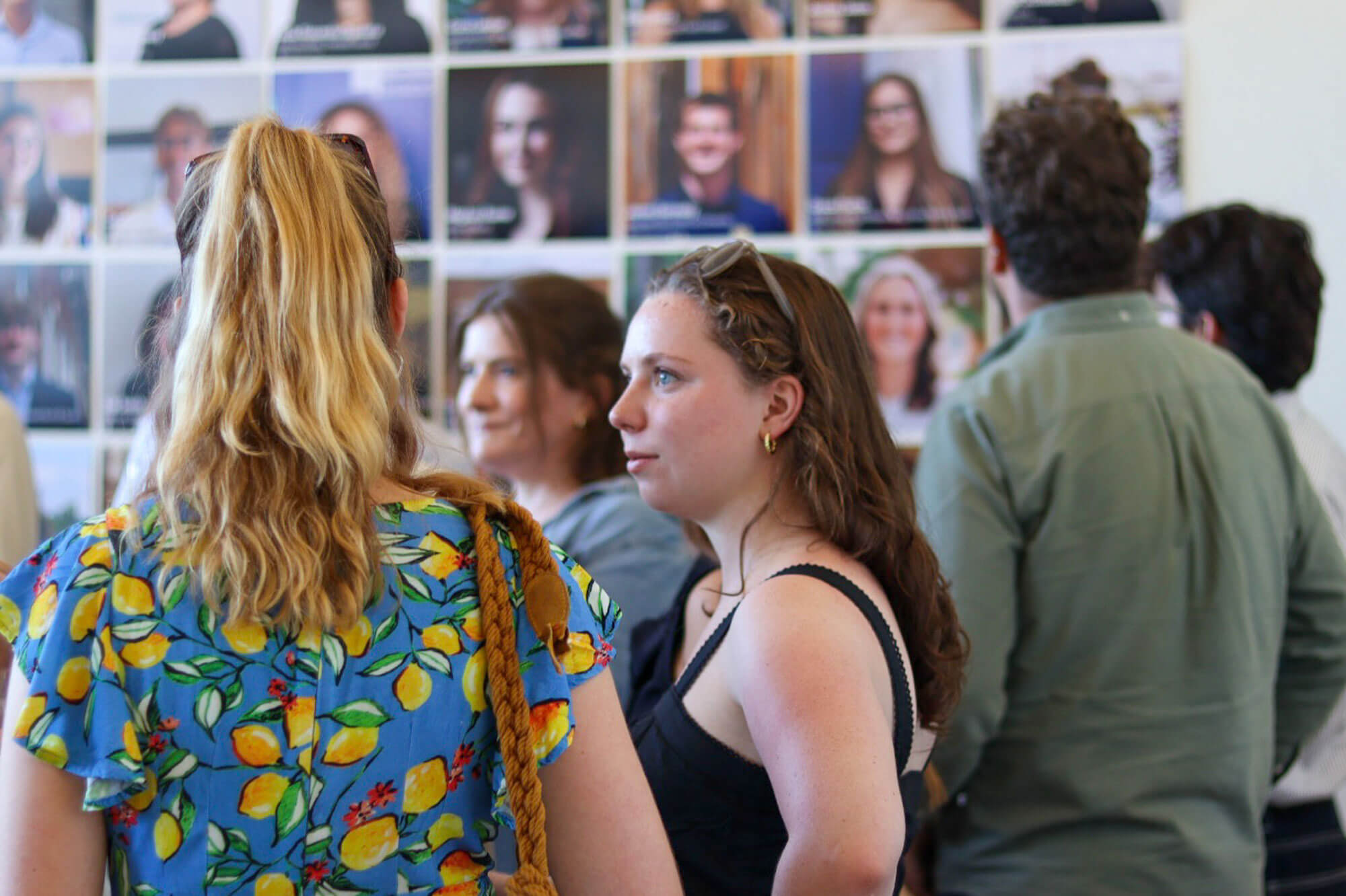
<figure class="image image-default"><img src="https://global.nd.edu/assets/671968/fullsize/dublin.jpg" alt="Crowd views a wall of portraits. Prominent: woman in lemon dress, woman in black, man in green shirt facing wall." width="2000" height="1332"></figure>
<p><a href="https://dublin.nd.edu">Notre Dame Dublin</a> held its annual end-of-summer celebration for the <a href="https://dublin.nd.edu/programs/irish-internship-program/">Irish Internship Program</a> at O’Connell House. The team was joined by the most recent cohort of interns, respective partners, and benefactors, bringing the 8-week program to a close. Across the two months, students were immersed in the work of their host organizations, working alongside Irish employees and gaining valuable, pragmatic experience, as one step in kick-starting their career trajectory.</p>
<hr>
<h2>ROME</h2>
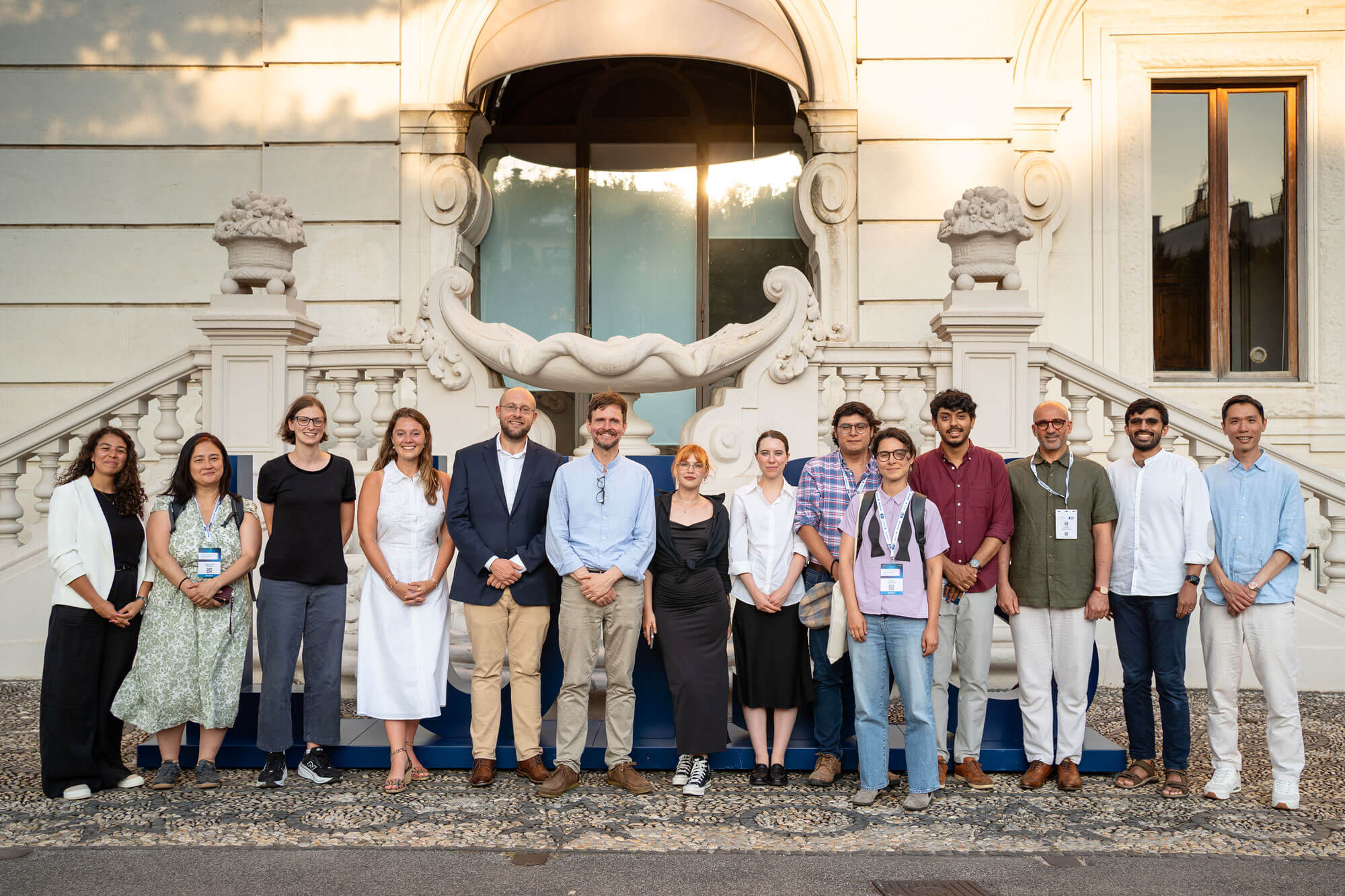
<figure class="image image-default"><img src="https://global.nd.edu/assets/671962/fullsize/rome.jpg" alt="Diverse group of 14 smiling adults in varied attire, standing before an ornate building with a large arched window." width="2000" height="1333"></figure>
<p>Participants of the 2026 <a href="https://rome.nd.edu/it/research/projects-activities/rome-summer-seminars-on-religion-and-global-politics/">Rome Summer Seminars on Religion and Global Politics</a> pose with Michael Driessen (pictured center), professor of political science and international affairs and director of the MA in international affairs at John Cabot University, who organized the program in collaboration with <a href="https://rome.nd.edu">Notre Dame Rome</a>. Drawing on Rome’s distinctive religious and geopolitical landscape, the two-week program brought together graduate students from around the world working at the crossroads of religion and global politics through public panels, expert lectures, seminars with leading international scholars and members of the diplomatic community, as well as site visits, writing workshops, and a policy dialogue. <em>Photo credit: Ansari Institute for Global Engagement with Religion, a valued partner of the Rome Summer Seminars on Religion and Global Politics.</em></p>
<hr>
<h2>MEXICO</h2>
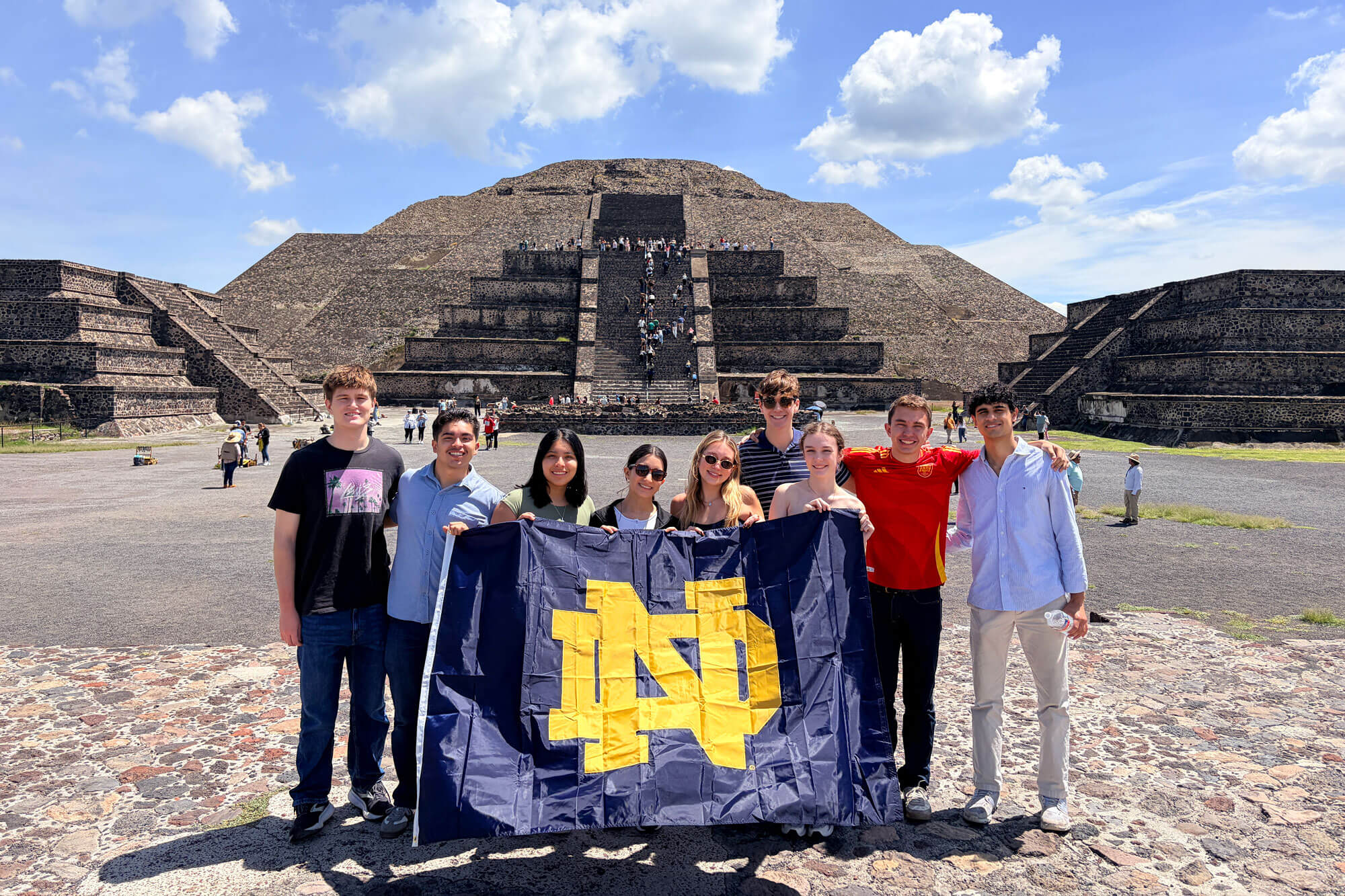
<figure class="image image-default"><img src="https://global.nd.edu/assets/671967/fullsize/mexico.jpg" alt="Eight smiling students hold a navy blue and gold Notre Dame flag in front of the Pyramid of the Sun at Teotihuacan." width="2000" height="1333"></figure>
<p><a href="https://mexico.nd.edu">Notre Dame Mexico</a> concluded the 2026 <a href="https://studyabroad.nd.edu/programs/global-professional-experience-program/">Global Professional Experience</a> (GPE) and <a href="https://studyabroad.nd.edu/programs/global-research-experience-program/">Global Research Experience</a> (GRE) programs in Mexico City. Over seven weeks, students took part in a wide variety of professional and research placements at places like AmCham/Mexico, the Mexico-United States Commission for Educational and Cultural Exchange (COMEXUS), and Escuela Nacional de Ciencias Biológicas, among others—while immersing themselves in Mexico's culture and building connections with local partners and communities.</p>
<hr>
<h2>GLOBAL ENGAGEMENT PROGRAMS</h2>
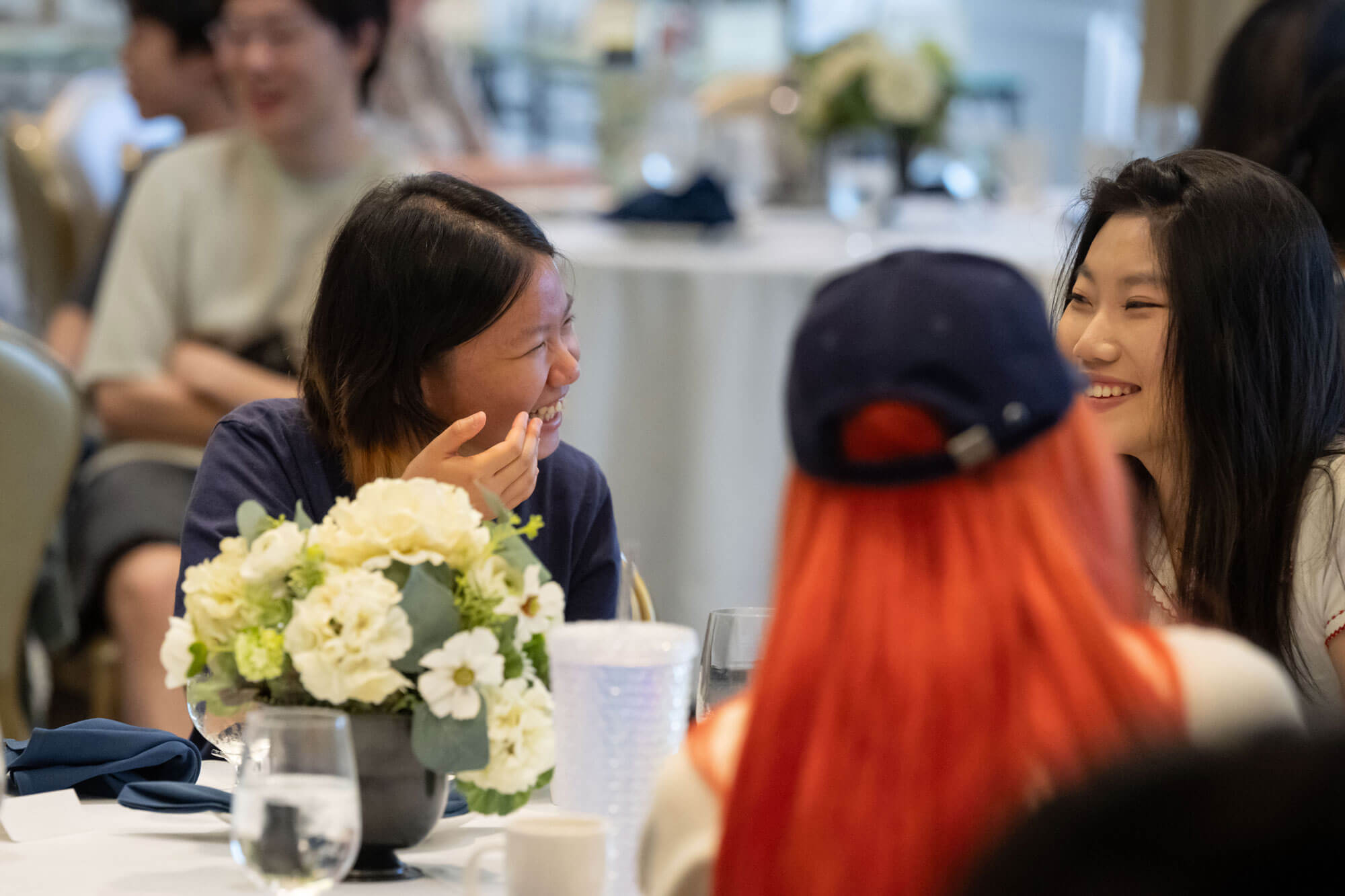
<figure class="image image-default"><img src="https://global.nd.edu/assets/671966/fullsize/gep.jpg" alt="Two young women smile and laugh while conversing at a table with white floral centerpieces at a formal event." width="2000" height="1333"></figure>
<p>The second cohort of the <a href="https://ndi-sa.nd.edu/index.cfm?FuseAction=Programs.ViewProgramAngular&amp;id=10096">International Summer Undergraduate Research Experience</a> (iSURE) program arrived in July, kicking off eight weeks of research, professional development, and community building. The group of 44 students will gain hands-on research experience, working closely with Notre Dame faculty and graduate students on a variety of projects. Through a personalized and interdisciplinary approach to mentoring and academic immersion, the iSURE program aims to nurture each student’s personal, academic, and intercultural growth throughout their time on campus. </p>
<hr>
<h2>JERUSALEM</h2>
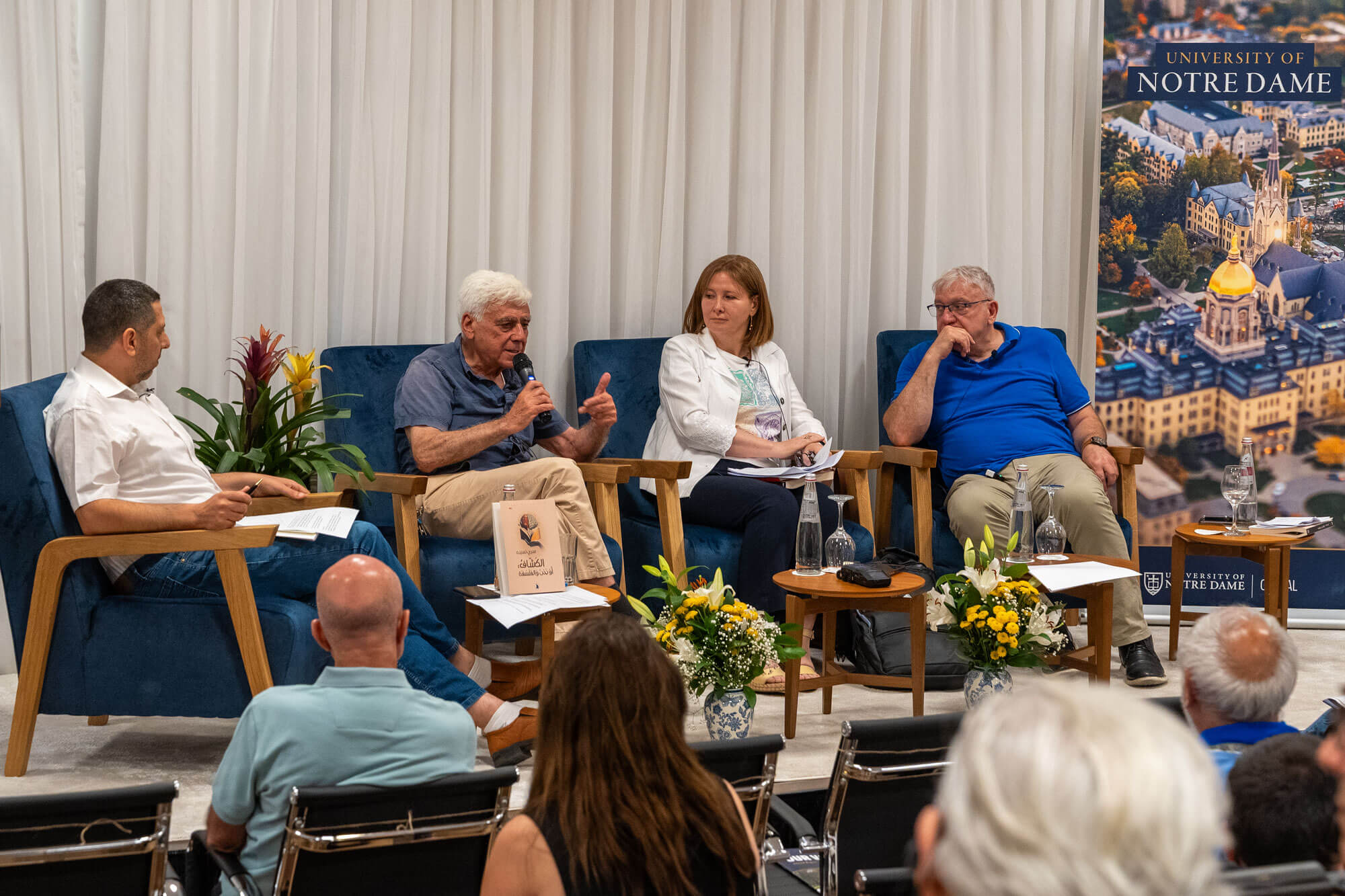
<figure class="image image-default"><img src="https://global.nd.edu/assets/671963/fullsize/jerusalem.jpg" alt="A white-haired man in a blue shirt speaks into a microphone on a panel with three others. A Notre Dame campus banner is visible." width="2000" height="1333"></figure>
<p><a href="https://jerusalem.nd.edu">Notre Dame Jerusalem</a> hosted a conversation featuring Prof. Sari Nusseibeh and other distinguished panelists during <a href="https://global.nd.edu/news-events/news/notre-dame-jerusalem-hosts-book-launch-for-professor-sari-nusseibehs-newest-book-em-the-scout-philosophy-and-us-em/">the launch</a> of <em>The Scout: Philosophy and Us, </em>which explores the practical application of philosophical thinking and methods to address deep societal challenges. </p>
<hr>
<h2>MUMBAI</h2>
<figure class="image image-default"><img src="https://global.nd.edu/assets/671965/fullsize/mumbai.jpg" alt="Eight smiling adults, including a man in a turban, hold a blue and gold Notre Dame flag in a hotel lobby." width="2000" height="1333"></figure>
<p>Notre Dame alumni, students, and parents gathered at the Novotel Hotel, Juhu, Mumbai for the annual <a href="https://mumbai.nd.edu">Notre Dame Mumbai</a> student sendoff. This year's incoming Indian students represent various parts of the country, including Bengaluru, Hyderabad, Kolkata, and Mumbai—and will pursue majors in a wide range of disciplines, including architecture, biological sciences, business, economics, environmental sciences, and physics.</p>
<hr>
<h2>BEIJING</h2>
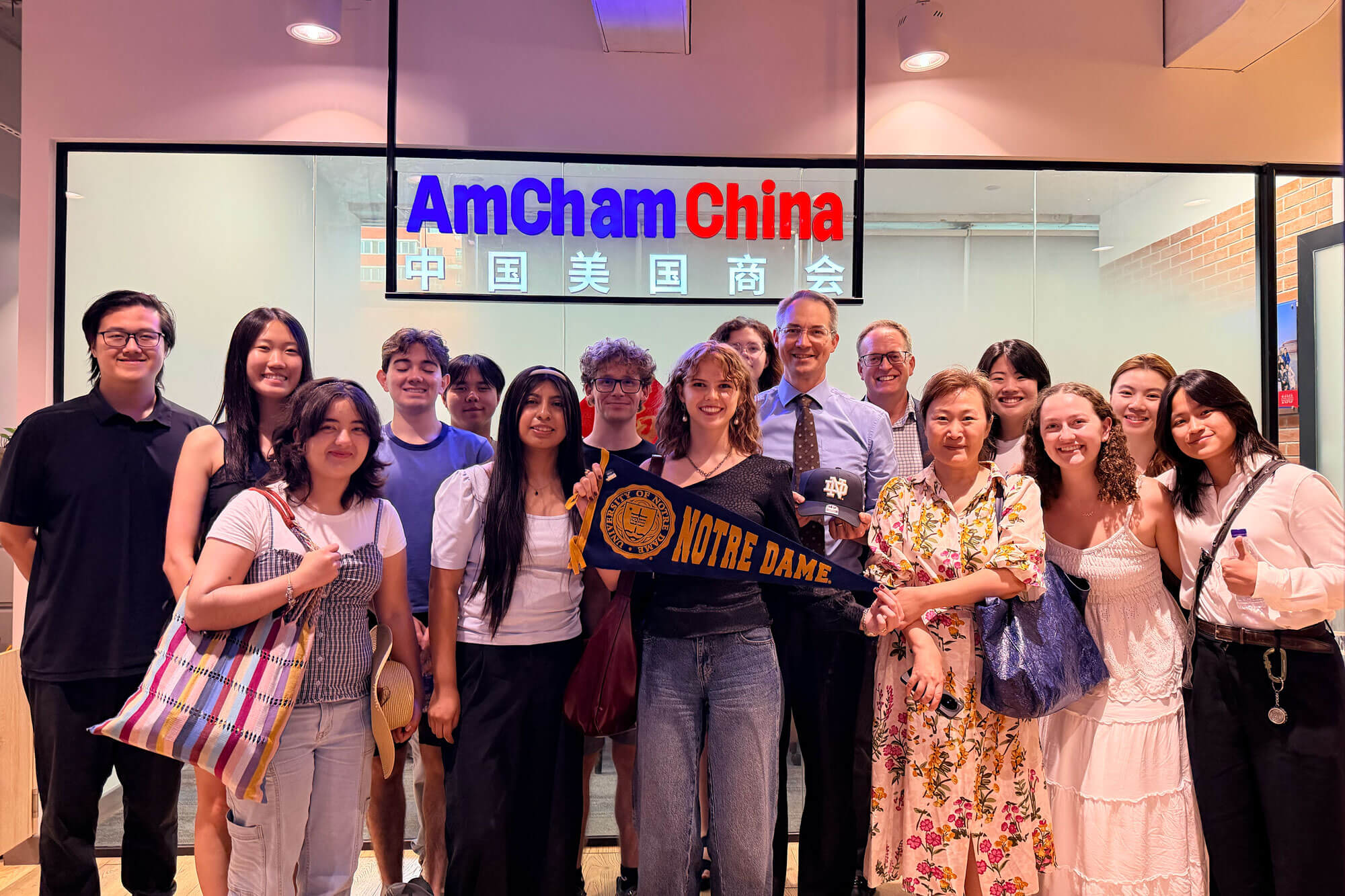
<figure class="image image-default"><img src="https://global.nd.edu/assets/671964/fullsize/beijing.jpg" alt="Smiling students and adults stand by the AmCham China sign. A woman holds a Notre Dame pennant, a man holds an ND hat." width="2000" height="1333"></figure>
<p><a href="https://ndi-sa.nd.edu/index.cfm?FuseAction=Programs.ViewProgram&amp;Program_ID=10184">Beijing Summer</a> students visited the American Chamber of Commerce in China (AmCham China) to learn about the US-China business environment and the Chamber’s work supporting the American business community in China. Through presentations and an interactive Q&amp;A with Chamber leadership, students gained firsthand insights into business, communications, and cross-cultural engagement.</p>
<hr>
<h2>SÃO PAULO</h2>
<figure class="image image-default"><img src="https://global.nd.edu/assets/671961/fullsize/saopaulo.jpg" alt="A diverse group of smiling people standing in rows in a well-lit classroom." width="2000" height="1333"></figure>
<p>Notre Dame faculty and researchers joined colleagues from Brazilian universities for a collaborative workshop on energy and chemical conversion at IQ-UNESP in Araraquara, Brazil. The gathering brought together Notre Dame’s David Go and Edward Maginn, visiting researcher José Balena Gabriel Filho, <a href="https://saopaulo.nd.edu">Notre Dame São Paulo</a> Director Thais Burmeister Pires, and fellow researchers to exchange ideas and advance scientific collaboration.</p>
<hr>
<h2>SANTIAGO</h2>
<figure class="image image-default"><img src="https://global.nd.edu/assets/671960/fullsize/santiago.jpg" alt="Fifteen people pose smiling under a dark blue sky with many stars. Cacti grow on a rocky hill behind them." width="2000" height="2470"></figure>
<p>Students in <a href="https://santiago.nd.edu">Notre Dame Santiago</a>’s summer programs traveled to the Elqui Valley for an evening of stargazing. Known for its exceptionally clear skies and role in astronomical research, the valley offered students a chance to experience one of northern Chile’s most distinctive landscapes while learning more about the region’s connection to the night sky.</p>
<hr>
<p><em>This photo gallery highlights some of the valuable interactions and experiences Notre Dame faculty, staff, students, and alumni have taken part in over the past month. </em><em>The selection was curated by Notre Dame Global staff working on campus and in the University's <a href="https://global.nd.edu/global-network/">12 global locations</a>.</em></p>
<p class="attribution">Originally published by <span class="rel-author">Cory Hankins</span> at <span class="rel-source"><a href="https://global.nd.edu/news-events/news/notre-dame-global-in-photos-july-2026/">global.nd.edu</a></span> on <span class="rel-pubdate">August 07, 2026</span>.</p>]]>
    </content>
    <link rel="enclosure" type="image/jpeg" href="https://weareall.nd.edu/assets/672528/dublin.jpg" title="Crowd views a wall of portraits. Prominent: woman in lemon dress, woman in black, man in green shirt facing wall."/>
    <author>
      <name>Cory Hankins</name>
    </author>
  </entry>
  <entry>
    <id>tag:weareall.nd.edu,2005:News/184671</id>
    <published>2026-08-04T14:45:00-04:00</published>
    <updated>2026-08-11T14:45:33-04:00</updated>
    <link rel="alternate" type="text/html" href="https://weareall.nd.edu/our-stories/news/ben-nelson-28-is-blending-sports-data-and-community/"/>
    <title>Ben Nelson '28 is blending sports, data, and community</title>
    <summary type="text">
      <![CDATA[Growing up in Menomonee Falls, Wisconsin, Ben Nelson ’28 always knew that college would need to be the right fit academically,…]]>
    </summary>
    <content type="html">
      <![CDATA[<p><img src="https://youtu.be/dQXRWQLGGAE" alt=""><iframe width="1040" height="583" src="https://www.youtube.com/embed/dQXRWQLGGAE" allowfullscreen="allowfullscreen"></iframe></p>
<p>Growing up in Menomonee Falls, Wisconsin, Ben Nelson ’28 always knew that college would need to be the right fit academically, socially, and personally. As someone passionate about technology, math, and sports, he wanted a university where he could pursue big goals while also finding a strong sense of community and support.</p>
<p>Now majoring in <a href="https://cse.nd.edu/">computer science</a> and <a href="https://acms.nd.edu/">applied and computational mathematics and statistics (ACMS)</a>, Nelson has found exactly that at Notre Dame.</p>
<figure class="image image-right"><img src="https://admissions.nd.edu/assets/660208/500x/bennelsonandfriends.jpg" alt="Three smiling men, two standing, one in a wheelchair. One wears a navy ND Irish shirt, another a green ND polo, one a purple shirt." width="500" height="678">
<figcaption>Ben Nelson '28 (center) with roommates Sean Mayer and Nate Bernstein</figcaption>
</figure>
<p>“I’ve always loved technology, and I’ve always really enjoyed math,” he says. “This combination lets me pursue both.”</p>
<p>Originally, Nelson planned to study aerospace engineering and even joined Notre Dame’s Rocketry Team during his first year. But over time, he realized his interests were pulling him in a different direction. Inspired by the growing intersection of sports and analytics, he began shaping a path toward data science and sports analytics.</p>
<p>A lifelong Wisconsin sports fan, Nelson hopes to one day work in professional sports, possibly even as a general manager for a team.</p>
<p>“I love the intersection of data science, data analytics, and sports,” he says. “That’s the dream someday.”</p>
<p>When searching for colleges, Nelson and his family considered several factors: strong academics, spirited athletics, proximity to home, and a campus culture that would fully support him as a student with a disability.</p>
<p>Notre Dame immediately stood out among the universities he visited.</p>
<p>“We were very nervous,” Nelson recalls of his family’s first campus visit. “But everyone at Sara Bea Accessibility Services was so welcoming and kind. It felt like, ‘If I get in here, this is going to be a no-brainer.’”</p>
<p>From the moment he arrived on campus, Nelson found himself embraced by the Notre Dame community. He still remembers move-in day at his residence hall, Graham Family Hall, when fellow students immediately jumped in to help carry his equipment and get him settled.</p>
<p>“If these guys are willing to help a random stranger they’ve known for five minutes,” he remembers thinking, “this must be a pretty amazing place.”</p>
<p>That feeling has only deepened during his time on campus.</p>
<p>Nelson credits <a href="https://studenthealth.nd.edu/center-for-student-support-and-care/accommodations-support/">Sara Bea Accessibility Services</a> with helping coordinate accommodations and support systems that have allowed him to thrive academically and personally. He has also become involved in several organizations supporting students with disabilities, including <a href="https://www.instagram.com/ndaccess_able/">Access-ABLE</a> and student government initiatives focused on accessibility improvements across campus.</p>
<p>At the same time, he has immersed himself in student life through his other passions. Nelson is also in the Sports Analytics Club, where students partner with varsity athletic teams to create and analyze performance data. He currently works with the men’s lacrosse team. In addition, he helps organize section sports in Graham Family Hall.</p>
<p>“I love the dorms. I love Graham,” he says. “Community is definitely the brand here.”</p>
<p>For Nelson, Notre Dame’s spirit comes from the way it brings together people from vastly different backgrounds in pursuit of something bigger than themselves.</p>
<p>“Notre Dame is a place that brings a lot of different people together,” he says. “People from all over the world are all here trying to better themselves and help make the world a better place.”</p>
<p>He believes that collaborative spirit sets Notre Dame apart from many other universities. “It’s much more driven toward a higher purpose,” he says.</p>
<figure class="image image-right"><img src="https://admissions.nd.edu/assets/660238/350x/bennelsonandparents.jpg" alt="Ben Nelson and parents" width="350" height="416">
<figcaption>Nelson with his parents at Rocky Mountain National Park in Colorado</figcaption>
</figure>
<p>As Nelson has adjusted to college life, one lesson has especially shaped his experience: learning to give himself grace.</p>
<p>“I think the biggest thing I’ve learned is that it’s okay to fail,” he says. “You try so hard to have everything figured out immediately, especially as a student with a disability. But sometimes things don’t work the first time, and that’s okay. It’s not defeat. It’s a lesson.”</p>
<p>That mindset has helped him navigate both challenges and new opportunities while growing more independent during his college experience.</p>
<p>Among his favorite Notre Dame memories so far is spending a fun and carefree day with friends, cheering on the Fighting Irish football team during the 2024 Notre Dame vs. Indiana University playoff game and enjoying the simple joy of being part of campus life.</p>
<p>“We had no worries,” he says. “Everything was good. We were just hanging out together all day, watching a great game. It was one of the best days I’ve had here.”</p>
<p>For students with disabilities considering Notre Dame, Nelson hopes his experience offers encouragement.</p>
<p>“There are people here who want to help you succeed,” he says. “You have to give yourself grace and let yourself grow. That’s part of the experience.”</p>
<p><strong>Watch the video above to learn more about Nelson’s ND experience.</strong></p>
<p class="attribution">Originally published by <span class="rel-author">Shannon Rooney</span> at <span class="rel-source"><a href="https://admissions.nd.edu/visit-engage/stories-news/ben-nelson-28-is-blending-sports-data-and-community/">admissions.nd.edu</a></span> on <span class="rel-pubdate">August 04, 2026</span>.</p>]]>
    </content>
    <link rel="enclosure" type="image/webp" href="https://weareall.nd.edu/assets/672551/bennelsonthumbnail.webp" title="Smiling man in a purple shirt and wheelchair flanked by two standing men. One wears a navy &quot;ND IRISH&quot; shirt, the other a green ND polo."/>
    <author>
      <name>Shannon Rooney</name>
    </author>
  </entry>
  <entry>
    <id>tag:weareall.nd.edu,2005:News/184672</id>
    <published>2026-08-04T09:47:00-04:00</published>
    <updated>2026-08-11T14:48:29-04:00</updated>
    <link rel="alternate" type="text/html" href="https://weareall.nd.edu/our-stories/news/habitat-for-humanity-to-hold-on-campus-home-ownership-information-sessions/"/>
    <title>Habitat for Humanity to hold on-campus home ownership information sessions</title>
    <summary type="text">
      <![CDATA[Habitat for Humanity of St. Joseph County will host two on-campus information sessions on Wednesday, August 19, for employees interested in building a new home through the agency. The meetings will be held at 10:00 a.m. and 2:30 p.m. in Room 127 in the Mason Services Center. Interested employees are…]]>
    </summary>
    <content type="html">
      <![CDATA[<p>Habitat for Humanity of St. Joseph County will host two on-campus information sessions on Wednesday, August 19, for employees interested in building a new home through the agency. The meetings will be held at 10:00 a.m. and 2:30 p.m. in Room 127 in the Mason Services Center. Interested employees are welcome to attend either session; the same information will be shared at both meetings. (<a href="https://map.nd.edu/#/placemarks/L0275/zoom/16/lat/41.70020314568804/lon/-86.246845777771">Click for campus map.</a>)</p>
<p>In 2027, Habitat has opportunities to build homes in South Bend and Mishawaka. Applicants are selected based on their demonstrated need for housing, ability to pay an affordable mortgage, and willingness to partner with Habitat and complete the program requirements.</p>
<p>Participating families work alongside volunteers to build their own homes. They also volunteer for Habitat for Humanity and participate in Habitat-sponsored homeownership classes. In doing so, they qualify for down payment assistance and competitive lending terms through Habitat and a local bank.</p>
<p>Habitat houses are quality, energy-efficient homes that range in size—between 1,200 to 1,400 square feet—and include three bedrooms, two bathrooms, a full basement, and a one-stall garage. Projected mortgage payments will not exceed 30 percent of a family’s gross income.<br><br>Habitat for Humanity of St. Joseph County is an equal housing opportunity lender and nonprofit that offers home ownership opportunities to people of low to moderate income who have been priced out of the housing market due to rising real estate prices and narrow access to lending.</p>
<hr>
<p><em><strong>Note: Habitat for Humanity of St. Joseph County will select program participants based on its qualifying criteria. The opportunity to build with Habitat is not reserved for University of Notre Dame employees, and the University is not offering loan or other home ownership assistance to its employees.</strong></em></p>
<p class="attribution">Originally published by <span class="rel-author">Office of Public Affairs</span> at <span class="rel-source"><a href="https://ndworks.nd.edu/news/habitat-for-humanity-to-hold-on-campus-home-ownership-information-sessions/">ndworks.nd.edu</a></span> on <span class="rel-pubdate">August 03, 2026</span>.</p>]]>
    </content>
    <link rel="enclosure" type="image/jpeg" href="https://weareall.nd.edu/assets/672555/paff_6147_hfh_graphics_2024_conductor_2_.jpg" title="A graphic that says Habitat for Humanity home ownership meetings. It is on a golden background with two photos of homes."/>
    <author>
      <name>Office of Public Affairs</name>
    </author>
  </entry>
  <entry>
    <id>tag:weareall.nd.edu,2005:News/183397</id>
    <published>2026-08-03T08:00:00-04:00</published>
    <updated>2026-07-28T16:37:45-04:00</updated>
    <link rel="alternate" type="text/html" href="https://weareall.nd.edu/our-stories/news/dc-bridge-builders-maria-rossi-20-on-connecting-ideas-and-people-at-the-keough-schools-washington-office/"/>
    <title>DC Bridge Builders: Maria Rossi ’20 on connecting ideas and people at the Keough School’s Washington Office</title>
    <summary type="text">
      <![CDATA[The Keough School of Global Affairs’ Washington Office Senior Operations and Outreach Coordinator reflects on how shared purpose builds bridges between academia and policymakers]]>
    </summary>
    <content type="html">
      <![CDATA[<p>As Senior Operations and Outreach Coordinator at the <a href="https://keough.nd.edu/about/keough-school-in-washington/">Keough School of Global Affairs Washington Office</a>, <strong>Maria Rossi ’20</strong> works at the intersection of academia and public policy, helping translate Keough faculty expertise into real-world impact.</p>
<p>She supports visiting faculty and students, helps drive programs that extend the Keough School’s reach in DC, and coordinates engagement for students and the school’s growing network of Washington-based alumni.</p>
<p>“Bridge-building is front and center in my work at Keough,” Maria says. “The purpose of our office is to be a bridge between the Keough School in South Bend and Washington, DC. A lot of the work I support involves using Keough faculty research to inform policy – connecting academia and the policymaking world.”</p>
<p>While academics and policymakers might speak different languages, Maria sees shared values at their core.</p>
<p>“We talk about the policy world as though it’s some sort of other planet,” she says, “but both policymakers and academics are very mission-driven. They’re wonks with tons of knowledge and a deep interest in using it to make the world a better place. Looking for those similarities provides a lot of common ground to work with.”</p>
<h4>A Global Perspective on Connection</h4>
<p>Maria gained her bridge-building skills through international experiences, including studying abroad in Morocco, teaching in Guatemala, and serving as a Fulbright English teaching assistant in Luxembourg.</p>
<p>“Having lived in other countries, some very different from the United States, I can say it's absolutely important and helpful to be aware of cultural differences,” she says. “However, it’s equally important to avoid falling into the trap of overestimating the impact of cultural differences, or neglecting to consider cultural similarities.”</p>
<p>For example, while in Morocco, Maria initially worried her Catholic background might create a barrier in a predominantly Muslim country. Instead, she found shared ground.</p>
<p>“My host family often treated our faith practices as something we had in common,” she said. “My host mom would talk about me going to ‘prayers’ on Sunday at the Catholic church the same way she talked about her own family going to the mosque every Friday. Our differences became a bridge, not a barrier.”</p>
<h4>Notre Dame’s Role in Cultivating Bridge-Builders</h4>
<p>For Maria, institutions like Notre Dame play a vital role in fostering bridge-builders by providing opportunities to study alongside peers with diverse perspectives–experiences that continue to shape her work in Washington, DC.</p>
<p>“Notre Dame gave me opportunities to meet, study beside, and work with people I might not otherwise have had reason to,” she reflects. “That helped me develop my own skills in relating to people from backgrounds, cultures, and ideologies different from my own.”</p>
<hr>
<h4><em><strong>About The Series:</strong></em></h4>
<p><em>Inspired by University President Rev. Robert Dowd, C.S.C.,'s call for Notre Dame to be a community of bridge builders, DC Bridge Builders spotlights members of the Notre Dame community who are fostering collaboration and common purpose in our nation’s capital.</em></p>
<p><strong><em>Know someone building bridges in DC? <a href="https://docs.google.com/forms/d/e/1FAIpQLSftvmiaj4bc0TV556b-F6GBqn9dB4rEQiA6KIft94_a02m7wA/viewform">Nominate them here</a>.</em></strong></p>
<p class="attribution">Originally published by <span class="rel-author">Irene Levering</span> at <span class="rel-source"><a href="https://washingtonoffice.nd.edu/news-events/news/dc-bridge-builders-maria-rossi-20-on-connecting-ideas-and-people-at-the-keough-schools-washington-office/">washingtonoffice.nd.edu</a></span> on <span class="rel-pubdate">July 28, 2026</span>.</p>]]>
    </content>
    <link rel="enclosure" type="image/webp" href="https://weareall.nd.edu/assets/668175/maria_rossi_dc_bridge_builders.webp" title="DC Bridge Builders: Maria Rossi '20"/>
    <author>
      <name>Irene Levering</name>
    </author>
  </entry>
  <entry>
    <id>tag:weareall.nd.edu,2005:News/184675</id>
    <published>2026-07-29T15:15:00-04:00</published>
    <updated>2026-08-11T15:15:42-04:00</updated>
    <link rel="alternate" type="text/html" href="https://weareall.nd.edu/our-stories/news/in-memoriam-gilberto-cardenas-professor-emeritus-of-sociology-and-founding-director-of-the-institute-of-latino-studies/"/>
    <title>In memoriam: Gilberto Cárdenas, professor emeritus of sociology and founding director of the Institute of Latino Studies</title>
    <summary type="text">
      <![CDATA[Gilberto Cárdenas, professor emeritus of sociology and founding director of the Institute of Latino Studies (ILS) at the University of Notre Dame, died Sunday, July 26. He was 79. Cárdenas was born in post-World…]]>
    </summary>
    <content type="html">
      <![CDATA[<p>Gilberto Cárdenas, professor emeritus of <a href="https://sociology.nd.edu/">sociology</a> and founding director of the <a href="https://latinostudies.nd.edu/">Institute of Latino Studies</a> (ILS) at the University of Notre Dame, died Sunday, July 26. He was 79.</p>
<p>Cárdenas was born in post-World War II California, and the discrimination he faced as a Mexican American largely shaped his trajectory as a sociologist and scholar in Latino studies.</p>
<p>For more than five decades, Cárdenas devoted his life to expanding educational opportunity, advancing scholarship, and supporting artists and their work. He worked to ensure that future generations of artists, scholars, and community leaders would recognize the richness and importance of Latino history, culture, and the institutions that reflected them.</p>
<p>“Gil was one of the founders of Latino studies at Notre Dame. Ever since his arrival from the University of Texas, he recognized its importance, especially at a global Catholic research university, and devoted himself to its development,” said <a href="https://provost.nd.edu/people/john-mcgreevy/">John T. McGreevy</a>, the Charles and Jill Fischer Provost. “We share in the sadness of his death but also honor his many achievements."</p>
<p>As a young man, Cárdenas was involved in the Chicano Movement, and his activism connected him with leaders across movements for civil rights, labor justice, educational equity, and immigrant rights. This experience continued throughout his life, during which he served on presidential commissions, testified before Congress, and sat on national boards to ensure Latino communities had a place at the table wherever decisions about culture, education, and public life were made. Most notably, he was cited in <em>Plyler v. Doe </em>(1982), the U.S. Supreme Court decision affirming the constitutional right of undocumented children to receive a public education.</p>
<p>“Gilberto Cárdenas was indispensable to the development of Latino studies across the United States,” said <a href="https://anthropology.nd.edu/people/alex-e-chavez/">Alex E. Chávez</a>, associate professor of anthropology, who worked with Cárdenas as an ILS postdoctoral student. “He devoted his life to building institutions in order to advance scholarship in the U.S. Latinos, expand opportunities in education and the arts, and further civil rights causes. He was a dear friend and a beloved mentor whose generosity, kindness, and compassion knew no bounds.”</p>
<p>Cárdenas received his Ph.D. in sociology from Notre Dame in 1975. During his time as a student, he studied under professor <a href="https://latinostudies.nd.edu/about/history/julian-samora/">Julián Samora</a> and co-authored <em>Los Mojados: The Wetback Story,</em> which redefined the study of immigration and Mexican American experiences. After graduation, he joined the faculty at the University of Texas at Austin and built up the <a href="https://iuplr.org/">Inter-University Program for Latino Research (IUPLR)</a>, the oldest national consortium focused on Latino research. He authored, co-authored, and co-edited dozens of books and scholarly articles during his academic career.</p>
<p>Cárdenas returned to Notre Dame in 1999 as a professor of sociology and relocated IUPLR to campus. Upon his return, he was also appointed the founding director of ILS. For 13 years, Cárdenas led the institute and established many of the hallmark programs and initiatives that remain today, including the <a href="https://latinostudies.nd.edu/undergraduate/supplementary-major/">academic program</a>, the literary initiative <a href="https://latinostudies.nd.edu/news-events/letras-latinas/">Letras Latinas</a>, and <a href="https://latinostudies.nd.edu/community/">community engagement efforts</a>. Through ILS, Cárdenas hoped to make Notre Dame "the premier place in the nation to study Latino populations.”</p>
<figure class="image image-left"><img src="https://al.nd.edu/assets/668189/20251104_jlh_jason_ruiz_office_018_600x.jpg" alt="Large painting of distressed crowd under stormy sky with lightning. A bookshelf and marble table are in the room." width="600" height="450">
<figcaption>A mural by artist Maceo Montoya, which was a part of Gil Cardenas' collection, hangs in Jason Ruiz's office. (Photo by Jon L. Hendricks/University of Notre Dame)</figcaption>
</figure>
<p>“In many respects, my work at Notre Dame would not have been possible without Gil. When I was a graduate student here, he went out of his way to support me — so much so that he offered me a job, leading to the creation of Letras Latinas. His prescient vision changed my life,” said <a href="https://latinostudies.nd.edu/people/personnel/francisco-aragon/">Francisco Aragón</a>, professor of the practice and director of Letras Latinas. “I can easily imagine this being the case for other artists and scholars who worked with him.”</p>
<p>Cárdenas’ impact also remains visible in the institute hallways in Bond Hall. Cárdenas was a lifelong supporter of the arts and had a particular commitment to preserving the visual history of the Chicano Movement. His collection of Latino/a/x art has become one of the most significant ever assembled, and many of the pieces are displayed throughout ILS spaces.</p>
<p>"From our first meeting — and for years to come — he has been a generous colleague, devoted friend, and staunch advocate for Latino studies,” said <a href="https://latinostudies.nd.edu/people/personnel/jason-ruiz/">Jason Ruiz</a>, professor of American studies and director of ILS. “The marks he made on the institute and, more broadly, in the field, are difficult to put into words, but he will be profoundly missed.”</p>
<p>Cárdenas is survived by his wife, Dolores Carrillo García; three children; three step-children, and nine grandchildren. A celebration of his life will be announced at a later date by the family.</p>
<p class="attribution">Originally published by <span class="rel-author">Mary Kinney</span> at <span class="rel-source"><a href="https://al.nd.edu/news/latest-news/in-memoriam-gilberto-cardenas-professor-emeritus-of-sociology-and-founding-director-of-the-institute-of-latino-studies/">al.nd.edu</a></span> on <span class="rel-pubdate">July 29, 2026</span>.</p>]]>
    </content>
    <link rel="enclosure" type="image/jpeg" href="https://weareall.nd.edu/assets/672568/img_9322_1200x.jpg" title="Older man with grey hair smiling warmly, wearing a blue, orange, and red geometric patterned shirt."/>
    <author>
      <name>Mary Kinney</name>
    </author>
  </entry>
  <entry>
    <id>tag:weareall.nd.edu,2005:News/183396</id>
    <published>2026-07-28T16:30:00-04:00</published>
    <updated>2026-07-28T16:30:49-04:00</updated>
    <link rel="alternate" type="text/html" href="https://weareall.nd.edu/our-stories/news/school-of-architecture-to-partner-with-city-of-benton-harbor-to-guide-redevelopment-of-riverfront/"/>
    <title>School of Architecture to partner with City of Benton Harbor to guide riverfront redevelopment</title>
    <summary type="text">
      <![CDATA[On Monday (Aug. 3), the University of Notre Dame School of Architecture’s Housing and Community Regeneration Initiative, in partnership with the City of Benton Harbor, the Southwest Michigan Planning Commission and Cornerstone Alliance, will launch a community-driven planning process to create a shared vision for the St. Joseph Riverfront in Benton Harbor.]]>
    </summary>
    <content type="html">
      <![CDATA[<p>On Monday (Aug. 3), the University of Notre Dame <a href="https://architecture.nd.edu/">School of Architecture</a>’s <a href="https://housingandcommunityregeneration.nd.edu/">Housing and Community Regeneration Initiative</a>, in partnership with the City of Benton Harbor, the Southwest Michigan Planning Commission and Cornerstone Alliance, will launch a community-driven planning process to create a shared vision for the St. Joseph Riverfront in Benton Harbor.</p>
<p>The partnership will begin with an invitation to residents, business owners and community stakeholders to participate in a series of listening sessions on Aug. 5, followed by a weeklong public urban planning session conducted by the Housing and Community Regeneration Initiative with public events on Aug. 17, 18 and 20. All events will start at 5:30 p.m. and be held at the Benton Harbor Urban Innovation Lab, 510 W. Main Street.</p>
<p>This process, known as a Dean’s Charrette, will result in a shared long-term vision for the riverfront as well as a regeneration plan for downtown, which will help guide future investments in housing, recreation, public spaces, connectivity and economic development.</p>
<p>"Our community’s waterfront represents our shared future — a future where neighbors come together to enjoy world-class public spaces, programming and recreation, where new housing and investment will flourish, and a place we can all be proud of for generations to come,” said Benton Harbor Mayor Marcus Muhammad. “This process gives our community the opportunity to move from ideas to action, transforming vacant spaces into vibrant places.”</p>
<blockquote>
<p>“This work will draw on Benton Harbor’s rich history and strong community to provide a plan to activate the riverfront and regenerate downtown by creating places of lasting value.”</p>
</blockquote>
<p>Directed by Professor <a href="https://architecture.nd.edu/about/directory/cusato/">Marianne Cusato</a>, the School of Architecture’s Housing and Community Regeneration Initiative will lead the planning and design process. Known for its collaborative "Think-and-Do Tank" approach, the initiative works alongside communities to develop practical, community-informed solutions that strengthen neighborhoods and local economies.</p>
<p>To date, the initiative has conducted nine charrettes in six cities across the region, including in South Bend, Elkhart and Gary, Indiana; and Kalamazoo, Michigan.</p>
<p>“We are thrilled to partner with Benton Harbor to facilitate a process that establishes a plan to offer actionable short-term recommendations which build toward a long-term vision for the city,” Cusato said. “This work will draw on Benton Harbor’s rich history and strong community to provide a plan to activate the riverfront and regenerate downtown by creating places of lasting value.”</p>
<p>The Riverview Drive corridor has long been identified as a redevelopment priority for the city, appearing in community planning efforts since the 1980s and in successive City of Benton Harbor Master Plans. This initiative, however, marks the first time the corridor will receive a dedicated action-focused plan supported by the necessary funding to move projects from vision to reality. It also builds upon previous plans, including the 2016 Twin Cities Harbor Vision and the 2020 Twin Cities Sustainable Small Harbors Plan.</p>
<p>Through these efforts, the Housing and Community Regeneration Initiative joins an ongoing partnership among the City of Benton Harbor, Cornerstone Alliance and the Southwest Michigan Planning Commission. A 2023 grant from the Michigan Department of Environment, Great Lakes and Energy to address high-water infrastructure challenges laid the groundwork for this phase, which will focus on resilient infrastructure, improved public access to the waterfront, stronger pedestrian connections and long-term flood resilience.</p>
<p>"Combined with the recently announced BUILD Grant, this planning effort creates an important foundation for Benton Harbor’s riverfront," said Andrew Haan, senior vice president of Cornerstone Alliance. "The community's ideas will drive this vision. By bringing together residents, local partners and technical expertise, we have an opportunity to create a riverfront that is welcoming, resilient and positioned to support future housing, investment and economic opportunity."</p>
<p>The project also includes a complementary downtown Benton Harbor master planning effort that will identify redevelopment opportunities for key sites while developing strategies for activation, beautification and long-term place management.</p>
<p>Everyone who lives, works or invests in Benton Harbor and the surrounding area is encouraged to participate.</p>
<p class="attribution">Originally published by <span class="rel-author">School of Architecture</span> at <span class="rel-source"><a href="https://news.nd.edu/news/school-of-architecture-to-partner-with-city-of-benton-harbor-to-guide-redevelopment-of-riverfront/">news.nd.edu</a></span> on <span class="rel-pubdate">July 28, 2026</span>.</p>]]>
    </content>
    <link rel="enclosure" type="image/jpeg" href="https://weareall.nd.edu/assets/668173/mc_72823_walsh_architecturejpg.jpg" title="The Walsh Family Hall of Architecture at the University of Notre Dame on a sunny day with wispy clouds. The light tan tower and shorter brick and tan building sections are seen from an angle across a green lawn.  A statue stands near the left side of the building."/>
    <author>
      <name>School of Architecture</name>
    </author>
  </entry>
  <entry>
    <id>tag:weareall.nd.edu,2005:News/183398</id>
    <published>2026-07-28T15:39:00-04:00</published>
    <updated>2026-07-28T16:39:42-04:00</updated>
    <link rel="alternate" type="text/html" href="https://weareall.nd.edu/our-stories/news/dc-bridge-builders-maggie-kmetz-mga-22-on-connecting-notre-dame-alumni-in-washington/"/>
    <title>DC Bridge Builders: Maggie Kmetz MGA ’22 on connecting Notre Dame alumni in Washington</title>
    <summary type="text">
      <![CDATA[The president of the Notre Dame Club of Washington, DC speaks to bringing alumni together through programming grounded in service, Notre Dame tradition, and local partnerships]]>
    </summary>
    <content type="html">
      <![CDATA[<p>As president of the <a href="https://ndwashdc.org/page/about-1">Notre Dame Club of Washington, DC</a>, <strong>Maggie Kmetz MGA ’22</strong> leads one of the University’s largest alumni communities, helping Notre Dame graduates in the region find connection, friendship, and opportunities to serve.</p>
<p>The club is entirely volunteer-run and supports more than 16,000 constituents and 6,000 alumni across the Washington area. Through regular programming, it creates a space for alumni to stay engaged long after graduation. In April, the club <a href="https://my.nd.edu/page/outstanding-clubs">was recognized</a> as one of Notre Dame’s best alumni clubs in the country, winning the 2025 Outstanding Club of the Year award for its club size.</p>
<h4>Rooted in the Notre Dame Family</h4>
<p>Surrounded by the Notre Dame family since childhood, Maggie witnessed the strength of the Irish network early on.</p>
<p>“Notre Dame was integral to my childhood,” she recalls. “My grandfather attended law school, my uncle was a history major and later a lawyer, and my parents met in the Notre Dame marching band.”</p>
<p>Maggie earned her Master of Global Affairs from the <a href="https://keough.nd.edu/">Keough School of Global Affairs</a> in 2022, following two years as a Peace Corps Youth Development Volunteer in Morocco. Today, she works in the federal government.</p>
<p>“My professors and classmates in graduate school shaped my whole experience and I am so lucky to call DC home with friends that I met at Notre Dame,” she says. “That gift keeps giving as I’ve grown closer with alumni that I met at the club.”</p>
<h4><strong>Connecting and Serving in DC</strong></h4>
<blockquote class="pull">
<p>"It always amazes me how many Notre Dame alumni reside in our area. It’s not uncommon to see a Notre Dame baseball cap or sweatshirt on the Metro and offer a ‘Go Irish!’ on the way off the train.”</p>
</blockquote>
<p>In a fast-paced city, Maggie views the alumni club as a steady anchor.</p>
<p>“Connecting with each other is more important now than ever,” she says. “We have so many distractions in our lives, but there is so much to learn about ourselves and those we are in community with. Finding a way to foster human connection is at the core of my efforts to build bridges in Washington, DC.”</p>
<p>In 2025 alone, the club hosted 162 events, including game watches, volunteer outings, and social gatherings. The goal is simple: help alumni who live near each other actually get to know each other.</p>
<p>“It always amazes me how many Notre Dame alumni reside in our area,” Maggie says. “It’s not uncommon to see a Notre Dame baseball cap or sweatshirt on the Metro and offer a ‘Go Irish!’ on the way off the train.”</p>
<h4><strong>Living Notre Dame’s Bridge-Building Mission</strong></h4>
<p>For Maggie, bridge-building extends well beyond alumni circles. It also means showing up for the city, partnering with other universities and local organizations to host service opportunities, including toy drives and serving at local soup kitchens.</p>
<p>Maggie sees her work with the club as a natural extension of Notre Dame’s mission.</p>
<p>“Notre Dame exposes students to the world,” she reflects. “Notre Dame teaches us to open our arms to all and extend our reach to all. Exposure to different people, places, and cultures is essential for bridge builders.”</p>
<hr>
<h4><em><strong>About The Series:</strong></em></h4>
<p><em>Inspired by University President Rev. Robert Dowd, C.S.C.,'s call for Notre Dame to be a community of bridge builders, DC Bridge Builders spotlights members of the Notre Dame community who are fostering collaboration and common purpose in our nation’s capital.</em></p>
<p><strong><em>Know someone building bridges in DC? <a href="https://docs.google.com/forms/d/e/1FAIpQLSftvmiaj4bc0TV556b-F6GBqn9dB4rEQiA6KIft94_a02m7wA/viewform">Nominate them here</a>.</em></strong></p>
<p class="attribution">Originally published by <span class="rel-author">Irene Levering</span> at <span class="rel-source"><a href="https://washingtonoffice.nd.edu/news-events/news/dc-bridge-builders-maggie-kmetz-mga-22-on-connecting-notre-dame-alumni-in-washington/">washingtonoffice.nd.edu</a></span> on <span class="rel-pubdate">July 28, 2026</span>.</p>]]>
    </content>
    <link rel="enclosure" type="image/webp" href="https://weareall.nd.edu/assets/668177/maggie_kmetz_dc_bridge_builders.webp" title="DC Bridge Builders: Maggie Kmetz, MGA '22"/>
    <author>
      <name>Irene Levering</name>
    </author>
  </entry>
  <entry>
    <id>tag:weareall.nd.edu,2005:News/183385</id>
    <published>2026-07-28T14:44:00-04:00</published>
    <updated>2026-07-28T14:51:43-04:00</updated>
    <link rel="alternate" type="text/html" href="https://weareall.nd.edu/our-stories/news/having-coffee-with-greg-bond/"/>
    <title>Having coffee with . . . Greg Bond</title>
    <summary type="text">
      <![CDATA[A fan of history and sports, the archivist found a rare job that blends those interests. …]]>
    </summary>
    <content type="html">
      <![CDATA[<h4>A fan of history and sports, the archivist found a rare job that blends those interests.</h4>
<figure class="image image-right"><img src="https://weareall.nd.edu/assets/668128/mlc_52626_gregory_bond_09_1_.jpg" alt="Man in blue shirt behind table with sports artifiacts, including a Jackie Robinson doll and boxing gloves." width="600" height="400"></figure>
<p>When people hear about Greg Bond’s role at Notre Dame, they often assume it’s mainly about football. It’s not.</p>
<p>Bond is the first formal sports archivist in the University of Notre Dame Archives and also curator of the Joyce Sports Research Collection housed in another Hesburgh Library unit, Rare Books &amp; Special Collections.</p>
<p>His duties include maintaining Notre Dame sports-related materials in the archives and overseeing the Joyce collection, a vast assemblage well known among sports scholars. It’s one of the largest sports-history collections in the world and features books, periodicals, photographs and other items.</p>
<p>The University started acquiring non-Notre Dame sports-related materials in the 1960s, long before many people considered athletics a topic for serious research. “Notre Dame got a really good head start on gathering important sports-historical collections: books, ephemera and manuscripts,” says Bond, who joined the University in 2022. Scholars come from all over to delve into the materials.</p>
<p>The collection includes such rare artifacts as former player and sportswriter Sol White’s 1907 <em>History of Colored Base Ball,</em> a fragile volume documenting early Black baseball and its players; “Going to a Fight,” an 1819 hand-painted British scroll, about 13 feet long, which depicts people heading to watch a boxing match on a town green; and a 1950 Jackie Robinson doll in a Dodgers uniform.</p>
<p><a href="https://magazine.nd.edu/stories/having-coffee-with-greg-bond/">Read more. </a></p>]]>
    </content>
    <link rel="enclosure" type="image/jpeg" href="https://weareall.nd.edu/assets/668128/mlc_52626_gregory_bond_09_1_.jpg" title="Man in blue shirt behind table with sports artifiacts, including a Jackie Robinson doll and boxing gloves."/>
    <author>
      <name>Notre Dame Magazine</name>
    </author>
  </entry>
  <entry>
    <id>tag:weareall.nd.edu,2005:News/183399</id>
    <published>2026-07-28T14:14:00-04:00</published>
    <updated>2026-07-28T16:45:04-04:00</updated>
    <link rel="alternate" type="text/html" href="https://weareall.nd.edu/our-stories/news/notre-dame-press-promotes-dr-emily-king-to-editor-in-chief/"/>
    <title>Notre Dame Press promotes Emily King to editor-in-chief</title>
    <summary type="text">
      <![CDATA[The University of Notre Dame Press is thrilled to announce the promotion of Dr. Emily King to Editor-in-Chief. King has been with UND Press as Senior Acquisitions Editor since 2022. In her new position, King will oversee the Press’s…]]>
    </summary>
    <content type="html">
      <![CDATA[<p><!-- wp:paragraph --></p>
<p>The University of Notre Dame Press is thrilled to announce the promotion of <strong>Dr. Emily King</strong> to Editor-in-Chief. King has been with <span class="caps">UND</span> Press as Senior Acquisitions Editor since 2022. In her new position, King will oversee the Press’s acquisitions department, providing shape and strategic direction for the publishing list as a whole. She will function as a key member of the press’s leadership team, while also maintaining her acquisitions charge for strong titles in theology, philosophy, and religion.</p>
<p><!-- /wp:paragraph --><!-- wp:spacer {"height":"25px"} --></p>
<p><!-- /wp:spacer --><!-- wp:paragraph --></p>
<p>In her four years at <span class="caps">UNDP</span>, King has played a crucial role in the development and expansion of the press’s list of publications, acquiring award-winning titles including <em><a href="https://undpress.nd.edu/9780268210335/the-dignity-of-dependence/">The Dignity of Dependence: A Feminist Manifesto</a> </em>by Leah Libreso Sargeant and <em><a href="https://undpress.nd.edu/9780268208349/a-theology-of-health/">A Theology of Health: Wholeness and Human Flourishing</a> </em>by Tyler J. VanderWeele.</p>
<p><!-- /wp:paragraph --><!-- wp:spacer {"height":"25px"} --></p>
<p><!-- /wp:spacer --><!-- wp:paragraph --></p>
<p>Notre Dame Press Director, Stephen Wrinn, shares his enthusiasm about King’s promotion: “I couldn’t possibly be more excited to have Emily in this vital leadership role which will shape the future direction of Notre Dame Press. In her four years at the Press, she has displayed outstanding editorial vision, savvy publishing instincts, and an exceptional work ethic. Her contributions as Editor-in-Chief promise to be profound.”</p>
<p><!-- /wp:paragraph --><!-- wp:spacer {"height":"25px"} --></p>
<p><!-- /wp:spacer --><!-- wp:paragraph --></p>
<p>For more information, visit our website at <a href="https://undpress.nd.edu" type="link" id="undpress.nd.edu">undpress.nd.edu</a> or contact Stephanie Marchman at <a href="mailto:shoffma7@nd.edu">shoffma7@nd.edu</a>.</p>
<p><!-- /wp:paragraph --><!-- wp:spacer {"height":"25px"} --></p>
<p><!-- /wp:spacer --><!-- wp:paragraph --></p>
<p><strong><span class="caps">ABOUT</span> <span class="caps">THE</span> <span class="caps">UNIVERSITY</span> OF <span class="caps">NOTRE</span> <span class="caps">DAME</span> <span class="caps">PRESS</span></strong>: The University of Notre Dame Press is the largest Catholic university press in the world and publishes academic and general interest books that engage the most enduring questions of our time. The Press primarily publishes in areas that align with the academic strengths of the University of Notre Dame, including religion, philosophy, political science, American history, medieval studies, and Latin American studies. Through reviews, scholarly citations, and translations, Notre Dame Press books extend the reach and reputation of the University.</p>
<p class="attribution">Originally published by <span class="rel-author">Notre Dame Press News</span> at <span class="rel-source"><a href="https://undpressnews.nd.edu/news/notre-dame-press-promotes-dr-emily-king-to-editor-in-chief/">undpressnews.nd.edu</a></span> on <span class="rel-pubdate">July 28, 2026</span>.</p>]]>
    </content>
    <link rel="enclosure" type="image/jpeg" href="https://weareall.nd.edu/assets/668179/ek_promotion.jpg" title="Notre Dame Press promotes Dr. Emily King to Editor-in-Chief"/>
    <author>
      <name>Notre Dame Press News</name>
    </author>
  </entry>
  <entry>
    <id>tag:weareall.nd.edu,2005:News/183400</id>
    <published>2026-07-27T11:48:00-04:00</published>
    <updated>2026-07-28T16:49:07-04:00</updated>
    <link rel="alternate" type="text/html" href="https://weareall.nd.edu/our-stories/news/pivoting-toward-justice/"/>
    <title>Pivoting toward justice</title>
    <summary type="text">
      <![CDATA[Students embark on summer research for the common good July 22, 2026   This summer, the Institute for Social Concerns…]]>
    </summary>
    <content type="html">
      <![CDATA[<h2 class="wp-block-heading"><strong>Students embark on summer research for the common good</strong></h2>
<h4 class="wp-block-heading">July 22<strong>, 202</strong>6</h4>
<div class="wp-block-spacer" aria-hidden="true"> </div>
<p>This summer, the <a><strong>Institute for Social Concerns</strong></a> placed 332 Notre Dame students with 150 partner organizations through its celebrated summer programs. Students spent the spring semester preparing for immersive summer experiences from New York to San Francisco, Belfast to Mumbai, where they would spend eight weeks conducting original research while engaging with local communities.</p>
<figure class="wp-block-image size-large"><img class="wp-image-25079" src="https://socialconcerns.nd.edu/wp-content/uploads/2026/07/Amelia-Lim_1-scaled-e1784904797778-1024x683.jpg" sizes="(max-width: 1024px) 100vw, 1024px" srcset="https://socialconcerns.nd.edu/wp-content/uploads/2026/07/Amelia-Lim_1-scaled-e1784904797778-1024x683.jpg 1024w, https://socialconcerns.nd.edu/wp-content/uploads/2026/07/Amelia-Lim_1-scaled-e1784904797778-300x200.jpg 300w, https://socialconcerns.nd.edu/wp-content/uploads/2026/07/Amelia-Lim_1-scaled-e1784904797778-768x512.jpg 768w, https://socialconcerns.nd.edu/wp-content/uploads/2026/07/Amelia-Lim_1-scaled-e1784904797778-1536x1024.jpg 1536w, https://socialconcerns.nd.edu/wp-content/uploads/2026/07/Amelia-Lim_1-scaled-e1784904797778-600x400.jpg 600w, https://socialconcerns.nd.edu/wp-content/uploads/2026/07/Amelia-Lim_1-scaled-e1784904797778.jpg 1920w" alt="" width="1024" height="683">
<figcaption class="wp-element-caption"><em>Amelia Lim ’29 (right) accompanies child to aquarium in Chennai, India</em></figcaption>
</figure>
<p>But when an Ebola outbreak gripped communities across East Africa, closing the region to outside visitors, 22 of these students saw their initial research plans evaporate.</p>
<p>Rather than abandoning their summer research, these students embraced a sudden pivot. Leveraging the institute’s decades of deeply rooted global and domestic partnerships, the students stepped into entirely new, unfamiliar environments—reframing their academic lenses to meet the unique needs of their new host communities.</p>
<h4 class="wp-block-heading">Designing architecture for a new climate in Chuuk, Micronesia</h4>
<p>For architecture major Wesley Buonerba ’27, the sudden change meant trading a plane ticket to Kenya for a journey to the remote island of Weno in Chuuk, Micronesia. Originally set to document Swahili building traditions in East Africa through a <a><strong>Summer Fellowship</strong></a>, Wesley adapted his research focus to the intense heat and heavy equatorial rains of the Pacific, studying how traditional Micronesian building practices cultivate essential vocational skills.</p>
<p>Wesley found a welcoming home at Xavier High School, a first-time partner organization for the institute. Along with teaching at the school and conducting his own research, Wesley found an unexpected opportunity for unique interdisciplinary collaboration.</p>
<figure class="wp-block-image size-large"><img class="wp-image-25078" src="https://socialconcerns.nd.edu/wp-content/uploads/2026/07/Wesley-Buonerba_1-scaled-e1784905115384-1024x683.jpeg" sizes="(max-width: 1024px) 100vw, 1024px" srcset="https://socialconcerns.nd.edu/wp-content/uploads/2026/07/Wesley-Buonerba_1-scaled-e1784905115384-1024x683.jpeg 1024w, https://socialconcerns.nd.edu/wp-content/uploads/2026/07/Wesley-Buonerba_1-scaled-e1784905115384-300x200.jpeg 300w, https://socialconcerns.nd.edu/wp-content/uploads/2026/07/Wesley-Buonerba_1-scaled-e1784905115384-768x512.jpeg 768w, https://socialconcerns.nd.edu/wp-content/uploads/2026/07/Wesley-Buonerba_1-scaled-e1784905115384-1536x1024.jpeg 1536w, https://socialconcerns.nd.edu/wp-content/uploads/2026/07/Wesley-Buonerba_1-scaled-e1784905115384-2048x1366.jpeg 2048w, https://socialconcerns.nd.edu/wp-content/uploads/2026/07/Wesley-Buonerba_1-scaled-e1784905115384-600x400.jpeg 600w" alt="" width="1024" height="683">
<figcaption class="wp-element-caption"><em>Wesley Buonerba ’27 (right) helps local residents with construction project in Chuuk, Micronesia</em></figcaption>
</figure>
<p>Rerouted with two other fellowship students, Jack Keller ’27, an electrical engineering and theology major, and David Nagy ’28, a PLS and psychology major with a minor in sustainability, Wesley found that the serendipitous confluence of their backgrounds in engineering, architecture, and sustainability allowed the trio to assist in the construction of a new building on the school’s campus.</p>
<p>“The experience here in Chuuk has almost been more compatible with my proposed research question,” Wesley shares. “Xavier afforded me not only the opportunity to teach in the classroom for a month but also the chance to practice construction in one of the world’s most remote environments. I’ve been able both to see how houses are constructed here in Chuuk and to participate in construction, gaining further insight into the state of the industry along the way.”</p>]]>
    </content>
    <link rel="enclosure" type="image/jpeg" href="https://weareall.nd.edu/assets/668181/amelia_lim_1.jpg" title="Amelia Lim ’29 (right) accompanies child to aquarium in Chennai, India"/>
    <author>
      <name>David Cramer</name>
    </author>
  </entry>
  <entry>
    <id>tag:weareall.nd.edu,2005:News/183259</id>
    <published>2026-07-21T09:00:00-04:00</published>
    <updated>2026-07-21T14:15:43-04:00</updated>
    <link rel="alternate" type="text/html" href="https://weareall.nd.edu/our-stories/news/researcher-shows-how-ai-can-personalize-learning-for-homeschooling-families/"/>
    <title>Researcher shows how AI can personalize learning for homeschooling families</title>
    <summary type="text">
      <![CDATA[A new study co-authored by Notre Dame researcher Mohammad Rashidujjaman Rifat shows how AI can help homeschooling parents build culturally responsive lesson plans that incorporate family heritage and cultural norms alongside age-appropriate educational standards.]]>
    </summary>
    <content type="html">
      <![CDATA[<figure class="image image-right"><img src="https://keough.nd.edu/assets/666961/homeschooling.jpg" alt="A mother works with her daughter on a lesson at home. A new study co-authored by a Notre Dame researcher explores how AI can support priorities of homeschooling parents, including adaptable routines, value-aligned materials and community-based support." width="600" height="400">
<figcaption>A mother works with her daughter on a lesson. A new study co-authored by a Notre Dame researcher explores how AI can support priorities of homeschooling parents, including adaptable routines, value-aligned materials and community-based support.</figcaption>
</figure>
<p>More than 3.4 million American children, or about 6 percent of the school-age population, now <a href="https://nheri.org/research-facts-on-homeschooling/">learn at home</a>, and that group has grown at nearly three times the <a href="https://education.jhu.edu/edpolicy/policy-research-initiatives/homeschool-hub/homeschool-growth-2024-2025/">pre-pandemic rate</a>. Homeschooling is also increasingly popular in countries including Canada and the United Kingdom, as more parents look to customize educational options for their children.</p>
<p>A new study co-authored by University of Notre Dame researcher <a href="https://keough.nd.edu/about/faculty-staff-directory/mohammad-rashidujjaman-rifat/">Mohammad Rashidujjaman Rifat</a> shows how artificial intelligence can empower parents to be engaged educators who tailor curriculums and learning plans that meet their children’s needs.</p>
<p>The study was published in the 2026 proceedings of the <a href="https://doi.org/10.1145/3772318.3791698">CHI Conference on Human Factors in Computing Systems</a>, the flagship conference for researchers working in human-computer interaction.</p>
<p>“School-centered platforms optimize for classroom control, standardized pacing and scale, but homeschooling families often prioritize adaptable routines, value-aligned materials and community-based support,” said Rifat, assistant professor of tech ethics and global affairs at Notre Dame’s <a href="https://keough.nd.edu/">Keough School of Global Affairs</a>. “We wanted to build something that keeps parents in control as reflective partners who shape what their children actually learn.”</p>
<p>Rifat and his colleagues designed a digital platform powered by a large language model. Their goal was to accommodate a diverse cohort of homeschooling families whose needs range from academic flexibility and cultural alignment to school safety concerns. During the study, they worked with Muslim families in the greater Toronto area, evaluating the platform’s usability and overall effectiveness from April to July 2025. Over time, they hope to work with larger groups in multiple communities.</p>
<p>Researchers designed the platform, called Homeroom, around three goals: supporting parents as active participants who shape their children's education; promoting culturally responsive personalization to help families create identity-affirming learning environments; and facilitating parents’ collaboration within a trusted circle of fellow homeschoolers.</p>
<p>The tool’s workflow enabled participants to brainstorm, create and refine stories for their children’s ethics education and to craft curriculums that incorporated family heritage and cultural norms alongside age-appropriate educational standards.</p>
<h2>Findings underscore need for agency, representation</h2>
<p>Researchers found that parents embraced a trust-but-verify approach, wanting to preview and edit educational materials before sharing them with their children. That desire for control was especially evident around cultural representation.</p>
<p>Some parents used the platform to fill gaps in available materials, generating stories that reflected their children’s cultural identities. One participant said she would use the tool primarily because heritage stories are difficult to find in libraries and too costly to keep buying. Parents appreciated being able to adjust tone, setting and cultural motifs including familiar foods, holidays and everyday customs until a story felt right for their child.</p>
<p>They also identified a need for precision around cultural values. When one participant asked the platform to generate stories emphasizing humility, she received moralizing narration rather than what she had in mind, which was a set of concrete, everyday practices her children already knew, such as sitting on the floor to eat. The experience pointed to a broader finding: Generic value labels are not enough. Families needed tools to define what those values actually look like in their household.</p>
<p>Researchers also found that participants preferred small, intimate groups over broad forums, which they found made it easier to ask sensitive questions and receive practical feedback. Parents wanted to follow trusted peers, adapt shared lessons while providing clear attribution and retain the option to monetize original content.</p>
<p>In addition, parents asked for tools to reduce administrative workload, including reusable rubrics, a portfolio generator and connections to local events that could feed directly into student records.</p>
<h2>Addressing a larger challenge in human-AI collaboration</h2>
<figure class="image image-right"><img src="https://keough.nd.edu/assets/666972/rifat_faculty_portrait.jpeg" alt="Mohammad Rashidujjaman Rifat is pictured. Rifat studies how AI can be designed inclusively to serve communities often overlooked by mainstream technology." width="600" height="400">
<figcaption>Mohammad Rashidujjaman Rifat studies how AI can be designed inclusively to serve communities often overlooked by mainstream technology.</figcaption>
</figure>
<p>The study is a natural extension of Rifat’s broader research agenda, which examines how AI can move beyond one-size-fits-all design to <a href="https://keough.nd.edu/news-and-events/news/exploring-ethical-ai-scholar-advocates-for-inclusive-community-centered-design/">better serve diverse communities</a> with distinct cultural needs and values.</p>
<p>It also addresses the concern that AI risks being sycophantic and simply reinforcing what the user already believes. While that risk is real, Rifat said, well-designed personalization can create space for communities to encounter difference rather than avoid it. Homeroom included features that exposed children to materials from outside their own background precisely for that reason.</p>
<p>“One of the critiques I hear is that we’re building echo chambers,” Rifat said. “But personalization is already happening whether we like it or not. The question is whether we design it in a way that brings communities together or drives them further apart.”</p>
<p>Rifat co-authored the study with Ayla Khan, a student at the University of Toronto Mississauga; Nouran Yahya, a student at the University of Waterloo and a research assistant at the University of Toronto Mississauga during the study; and Samar Sabie, assistant professor at the University of Toronto. The study received funding from the Urban Challenge Grant program at the University of Toronto’s School of Cities.</p>
<p>In addition to his role at the Keough School, Rifat holds a concurrent appointment in the <a href="https://cse.nd.edu/">Department of Computer Science and Engineering</a> within Notre Dame’s <a href="https://engineering.nd.edu/">College of Engineering</a>. He is also a faculty affiliate of the Keough School’s <a href="https://mckennacenter.nd.edu/">McKenna Center for Human Development and Global Business</a>, <a href="https://ansari.nd.edu/">Ansari Institute for Global Engagement with Religion</a> and <a href="https://pulte.nd.edu/">Pulte Institute for Global Development</a> as well as Notre Dame’s <a href="https://ethics.nd.edu/">Institute for Ethics and the Common Good</a> and <a href="https://lucyinstitute.nd.edu/">Lucy Family Institute for Data &amp; Society</a>.</p>
<p class="attribution">Originally published by <span class="rel-author">Josh Stowe</span> at <span class="rel-source"><a href="https://keough.nd.edu/news-and-events/news/researcher-shows-how-ai-can-personalize-learning-for-homeschooling-families/">keough.nd.edu</a></span> on <span class="rel-pubdate">July 20</span>.</p>
<p class="attribution"><em><strong>Contact: Tracy DeStazio</strong>, associate director of media relations, 574-631-9958 or <a href="mailto:tdestazi@nd.edu">tdestazi@nd.edu</a></em></p>]]>
    </content>
    <link rel="enclosure" type="image/jpeg" href="https://weareall.nd.edu/assets/667240/homeschooling_feature.jpg" title="A mother works with her daughter on a lesson at home. A new study co-authored by a Notre Dame researcher explores how AI can support priorities of homeschooling parents, including adaptable routines, value-aligned materials and community-based support."/>
    <author>
      <name>Josh Stowe</name>
    </author>
  </entry>
  <entry>
    <id>tag:weareall.nd.edu,2005:News/183196</id>
    <published>2026-07-21T08:00:00-04:00</published>
    <updated>2026-07-20T14:58:27-04:00</updated>
    <link rel="alternate" type="text/html" href="https://weareall.nd.edu/our-stories/news/defenders-of-religious-liberty-join-for-the-sixth-annual-notre-dame-religious-liberty-summit/"/>
    <title>Defenders of religious liberty join for the sixth annual Notre Dame Religious Liberty Summit</title>
    <summary type="text">
      <![CDATA[Each year, Notre Dame Law School hosts the Notre Dame Religious Liberty Summit, bringing together scholars, advocates, and faith leaders for discussions on complex religious liberty issues and the future of religious freedom in the United States and around the world.]]>
    </summary>
    <content type="html">
      <![CDATA[<p>Each year, Notre Dame Law School hosts the <a href="https://law.nd.edu/news-events/events/religious-liberty-summit/">Notre Dame Religious Liberty Summit</a>, bringing together scholars, advocates, and faith leaders for discussions on complex religious liberty issues and the future of religious freedom in the United States and around the world.</p>
<p>This year the <a href="https://law.nd.edu/news-events/events/religious-liberty-summit/2026-notre-dame-religious-liberty-summit/">sixth annual Notre Dame Religious Liberty Summit</a> featured over 20 speakers in 6 panel discussions on topics such as the religious foundations of the American Revolution, religious freedom and the making of free societies, and localism, state political experimentation, and religious freedom. Over 100 leading defenders of religious liberty gathered in Chicago, Illinois for the summit.</p>
<figure class="image image-right"><img src="https://law.nd.edu/assets/666089/dean_cole_opening_remarks.jpeg" alt="Man with dreadlocks, glasses, dark suit, yellow bow tie, and Notre Dame pin speaks at a podium with a microphone. ND banner behind him. (Dean Cole)" width="600" height="401">
<figcaption><em>Notre Dame Law School Dean G. Marcus Cole delivers opening remarks at the 2026 Notre Dame Religious Liberty Summit.</em></figcaption>
</figure>
<p><a href="https://law.nd.edu/directory/g-marcus-cole/">Dean G. Marcus Cole</a>, the Joseph A. Matson Dean and Professor of Law, introduced the theme in his opening remarks.</p>
<p>“The theme of this year’s summit is ‘We Hold These Truths…’ As we celebrate the 250th anniversary of the birth of our nation – the first nation in the history of the world to be founded upon the core principle of religious freedom – it is appropriate that we do so here in Chicago, a city in which virtually every faith in the world is represented,” said Dean Cole.</p>
<p>“The purpose of the Notre Dame Religious Liberty Summit is to explore issues, ideas, and strategies toward the protection and promotion of religious liberty, here in the United States and around the world.”</p>
<p>The panel discussions were grounded in the broader context of the nation’s 250th anniversary of the Declaration of Independence and reflected on the enduring principles of human dignity, freedom of conscience, and the God-given right of every person to live according to their beliefs.</p>
<figure class="image image-right"><img src="https://law.nd.edu/assets/666128/c9301457.jpeg" alt="Woman speaks at a podium during the Notre Dame Law School Religious Liberty Summit in Chicago. Panelists and audience present." width="600" height="401">
<figcaption><em>Professor Melissa Moschella speaks during the panel session “The Laws of Nature and of Nature's God: Natural Law and Rights."</em></figcaption>
</figure>
<p>In the first panel, “The Laws of Nature and of Nature's God: Natural Law and Rights,” <a href="https://mcgrath.nd.edu/about/faculty-staff/melissa-moschella-ph-d/">Professor Melissa Moschella</a>, a professor of philosophy at the University of Notre Dame, spoke on the sacred importance of religious liberty in our nation.</p>
<p>“If in line with the natural law tradition and the view of religion dominant in our nation's founding, we can understand religion as something objectively and distinctively valuable for human beings, not only as one among many goods that contribute to human fulfillment, but as a good that plays an architectonic that is a governing and structuring role in the good life. Then justice, and by extension law, requires giving it its special treatment in accordance with its special role in good life.”</p>
<p>In a keynote address, Dr. Jacqueline Rivers, the executive director of the Seymour Institute for Black Church and Policy Studies, spoke about the importance of engaging the Black Church in the defense of religious freedom.</p>
<p>"For African Americans, the relationship to religious freedom is quite complicated. As we celebrate the 250th anniversary of the signing of the Declaration of Independence and as we reflect on these truths that we hold to be self-evident, we need to recognize that for African Americans, for Black people, for enslaved Africans at the time of the founding, they were actually denied religious freedom.” said Rivers.</p>
<p>"We call on all the fighters for religious freedom to engage a powerful ally—the Black Church—by standing with us in the challenges we face."</p>
<figure class="image image-right"><img src="https://law.nd.edu/assets/666455/ca103952.jpeg" alt='Man, in a dark suit, speaks at a podium at the Notre Dame "We Hold These Truths" event in Chicago.' width="600" height="401">
<figcaption><em>Third-year law student Mintae Cha speaks during the panel session "The Religious Foundations of the American Revolution."</em></figcaption>
</figure>
<p>Additional panels were held on the <a href="https://law.nd.edu/news-events/news/2026-notre-dame-religious-liberty-summit-day-2-recap/">second day</a> of the summit including, “The Religious Foundations of the American Revolution” with Mr. Mintae Cha, a third-year law student at Notre Dame Law School, <a href="https://law.nd.edu/directory/daniel-slate/">Professor Daniel Slate</a> (Notre Dame Law School), and Professor John Witte (Emory University School of Law). The session was chaired by <a href="https://law.nd.edu/directory/nicole-garnett/">Professor Nicole Garnett</a> (Notre Dame Law School).</p>
<p>The third panel of the day featured a discussion on "Religious Freedom and the Making of Free Societies." Attendees heard from <a href="https://politicalscience.nd.edu/people/daniel-philpott/">Professor Daniel Philpott</a> (University of Notre Dame), Professor Allen Hertzke (University of Oklahoma), and Ms. Samah Norquist (Religious Freedom and Foreign Policy Expert). The session was chaired by <a href="https://law.nd.edu/directory/richard-garnett/">Professor Rick Garnett</a> (Notre Dame Law School).</p>
<p>The summit’s <a href="https://law.nd.edu/news-events/news/2026-notre-dame-religious-liberty-summit-day-3-recap/">final day</a> of academic programming featured a discussion on the “Localism, State Political Experimentation, and Religious Freedom” with insights from Professor Chris Lund (Wayne State University Law School), <a href="https://politicalscience.nd.edu/people/vincent-munoz/">Professor Phillip Muñoz</a> (University of Notre Dame), and Professor Mark Storslee (University of North Carolina School of Law). The session was chaired by <a href="https://law.nd.edu/directory/john-meiser/">Professor John Meiser</a> (Notre Dame Law School).</p>
<p>“State religion isn't like zoning or tax policies. Experimentation sometimes teaches us something, but basic rights are not things we should experiment with. If religion is a fundamental right, if it's a universal right, then it should be enjoyed universally,” shared panelist Chris Lund.</p>
<figure class="image image-right"><img src="https://law.nd.edu/assets/666464/meiser_2_.jpeg" alt="Man in a grey suit, white shirt, and red tie speaks at a podium, gesturing with his hand. Banner: Notre Dame Law School Religious Liberty Summit." width="600" height="401">
<figcaption><em>Professor John Meiser, director of the Lindsay and Matt Moroun Religious Liberty Clinic, speaks during the panel session “Localism, State Political Experimentation, and Religious Freedom."</em></figcaption>
</figure>
<p>"The heart of [the Declaration] was not simply protecting freedom in the abstract but indeed protecting the right of a people to independently govern themselves. It was a reaction against not just a political system that suppressed freedom but that violated the very idea that a community governs itself – and to resist a distant authority from outside," said Meiser.</p>
<p>Rabbi Meir Soloveichik of Congregation Shearith Israel delivered a keynote address on the final day of the summit. Rabbi Soloveichik serves as the rabbi of Congregation Shearith Israel, the oldest Jewish congregation in the United States, and as the director of the Zahava and Moshael Straus Center for Torah and Western Thought at Yeshiva University.</p>
<p>“America looked to the Jewish story as an indication of divine blessing and therefore as a source of inspiration for the sort of country America was called to be. The Jews were to be welcomed in America, Washington decided, not only because of the idea, but also because of the way in which the Jewish story inspired America itself,” said Soloveichik. "America's unity was never meant to come from sameness, but from a shared commitment to enduring principles."</p>
<p>“The warmth that Jews experienced in the nascent nation that was the United States can only be fully understood if we understand the way in which many founders and America in general saw the story of biblical Israel as a source of inspiration.”</p>
<figure class="image image-right"><img src="https://law.nd.edu/assets/666452/rabbi.jpeg" alt="Rabbi" width="600" height="401">
<figcaption><em>Rabbi Meir Soloveichik of Congregation Shearith Israel delivers a keynote address.</em></figcaption>
</figure>
<p>Drawing on the ideas of the late Chief Rabbi Lord Jonathan Sacks, Rabbi Soloveichik argued that American society, from the Pilgrim Fathers onward, was based on the concept of covenant as set out in the Tanakh, the Hebrew Bible, particularly in Exodus and Deuteronomy. He then quoted Rabbi Sacks, describing the United States as "that rare phenomenon: a covenant society. Covenant societies represent conscious new beginnings. They are founded on an idea, dedicated to a proposition."</p>
<p>"The rights we enjoy as Americans are fragile. They must be cherished, protected, and taught from generation to generation, because what may appear ordinary to us is actually extraordinary," said Soloveichik.</p>
<p>During lunch on Wednesday, participants enjoyed a screening of the trailer for the film “American Martyr: The Stanley Rother Story,”a feature-length documentary. The film tells the true story of Blessed Stanley Rother, an American priest from Oklahoma who was martyred after returning to Guatemala during the country's civil war, refusing to abandon the Indigenous people he served.</p>
<p>The trailer screening was followed by remarks from Michael Scaperlanda, chancellor for the Archdiocese of Oklahoma City. The documentary is heavily rooted in the work of Scaperlanda and his wife, María Ruiz Scaperlanda, who has spent decades championing Blessed Stanley Rother's legacy. Her book, “The Shepherd Who Didn't Run: Blessed Stanley Rother, Martyr from Oklahoma,” serves as a foundational text on his life.</p>
<p>Additional panels were held during the day, including “Religious Freedom and Abundance” offering insights from Professor Angela Carmella (University of Seton Hall Law School), Professor John Infranca (Suffolk University), and Mr. Jim Towey (Aging with Dignity). The session was chaired by <a href="https://law.nd.edu/directory/patrick-reidy/">Fr. Patrick Reidy, C.S.C.</a> (Notre Dame Law School).</p>
<figure class="image image-right"><img src="https://law.nd.edu/assets/666468/ca105142.jpeg" alt="Sister M. Petra Nielsen, in brown habit and glasses, speaks into a mic, gestures." width="600" height="401">
<figcaption><em>Sr. Petra Nielsen speaks during the panel session “Religious Freedom and the Catholic Mission in a Secular Age."</em></figcaption>
</figure>
<p>Lastly, “Religious Freedom and the Catholic Mission in a Secular Age” featured insights into religious freedom from a Catholic perspective. Panelists included Sr. Marie Morgan (Franciscan Alliance Inc.), Sr. Petra Nielsen (Franciscan Alliance Inc.), Fr. Jordi Pujol (Pontifical University of Santa Croce), Bishop Robert McClory (Diocese of Gary), and was chaired by <a href="https://law.nd.edu/directory/john-paul-kimes/">Msgr. John Paul Kimes</a> (Notre Dame Law School).</p>
<p>The Summit’s culminating event was the Religious Liberty Gala and Awards Dinner held on Wednesday, July 8.</p>
<p>During the dinner, the 2026 Notre Dame Prize for Religious Liberty was presented to the Becket Fund for Religious Liberty, a nonprofit public interest law firm based in Washington, D.C. with a mission to protect the free expression of all faiths.</p>
<figure class="image image-right"><img src="https://law.nd.edu/assets/666339/ca105967.jpeg" alt="Mark Rienzi, in a black tuxedo, speaks at a podium with the Notre Dame seal at the Religious Liberty Summit." width="600" height="401">
<figcaption><em>Mark Rienzi, president and CEO of the Becket Fund for Religious Liberty, accepts the 2026 Notre Dame Prize for Religious Liberty on behalf of the entire team at Becket.</em></figcaption>
</figure>
<p>Mark Rienzi, president and CEO, accepted the award on behalf of the Becket Fund.</p>
<p>"An award to the Becket Fund should be an award to the team at Becket,” said Rienzi. This is an ensemble effort. This is not any one person. The Becket Fund, from the start, has been a collection of highly talented people who decided to jump in and do a big thing together, and it really is a privilege and a blessing to be part of the team at Becket."</p>
<p>"Religious liberty helps real people, and it helps real people live out their faith... Religious liberty protects good things, and it makes those good things happen... It's a great joy and privilege for us to get to work on that."</p>
<p>The 2026 Religious Liberty Scholarship Award was presented to John Witte of Emory University School of Law. A leading specialist in legal history, human rights, religious freedom, marriage and family law, and law and religion, Witte has published over 300 articles, 18 journal symposia, and 45 books.</p>
<p>“Faith is the foundation of freedom, and religious freedom is the cornerstone of human rights. And orderly freedom, in turn, is the essential condition for the flourishing of both families and of faith in humanity. I am profoundly grateful for the 45 years of work that the good Lord has given me to do in this field,” said Witte.</p>
<figure class="image image-right"><img src="https://law.nd.edu/assets/666485/c9302112.jpeg" alt="People socialize on a boat deck overlooking Chicago's waterfront and skyline at dusk, seated at blue and yellow tables." width="600" height="401">
<figcaption><em>Summit attendees enjoyed a dinner cruise on the Chicago River and Lake Michigan.</em></figcaption>
</figure>
<p>The Summit also included cultural experiences for attendees, including a tour of the Field Museum, a natural history museum located in downtown Chicago, and a dinner cruise on the Chicago River and Lake Michigan. These opportunities provided a chance for continued dialogue among participants.</p>
<p>"The purpose of the Notre Dame Religious Liberty Summit is to serve as a forum to exchange ideas and discuss issues and to develop strategies to advance the fight for religious freedom in the United States and around the world,” said Dean Cole. “The summit and the conversations that we're having are central to our mission, both our Catholic mission as a law school, but also our mission and our vocation with regard to religious liberty.”</p>
<p><iframe width="560" height="315" src="https://www.youtube.com/embed/sK0d5rKqCVY?si=OlfaCxWIDmYGhgmq" title="YouTube video player" frameborder="0" allow="accelerometer; autoplay; clipboard-write; encrypted-media; gyroscope; picture-in-picture; web-share" referrerpolicy="strict-origin-when-cross-origin" allowfullscreen="allowfullscreen"></iframe></p>
<p><strong>More stories and news about the 2026 Notre Dame Religious Liberty Summit:</strong></p>
<ul>
<li dir="ltr" aria-level="1">
<p><a href="https://law.nd.edu/news-events/news/nd-law-will-hold-sixth-annual-religious-liberty-summit-in-chicago/">ND Law will hold sixth annual Religious Liberty Summit in Chicago</a></p>
</li>
<li dir="ltr" aria-level="1">
<p><a href="https://law.nd.edu/news-events/news/2026-notre-dame-religious-liberty-summit-dean-g-marcus-coles-opening-remarks/">2026 Notre Dame Religious Liberty Summit: Dean G. Marcus Cole’s opening remarks</a></p>
</li>
<li dir="ltr" aria-level="1">
<p><a href="https://law.nd.edu/news-events/news/2025-notre-dame-religious-liberty-summit-day-1-recap-2/">2026 Notre Dame Religious Liberty Summit: Day 1 Recap</a></p>
</li>
<li dir="ltr" aria-level="1">
<p><a href="https://law.nd.edu/news-events/news/2026-notre-dame-religious-liberty-summit-day-2-recap/">2026 Notre Dame Religious Liberty Summit: Day 2 Recap</a></p>
</li>
<li dir="ltr" aria-level="1">
<p><a href="https://law.nd.edu/news-events/news/2026-notre-dame-religious-liberty-summit-day-3-recap/">2026 Notre Dame Religious Liberty Summit: Day 3 Recap</a></p>
</li>
<li dir="ltr" aria-level="1">
<p><a href="https://law.nd.edu/news-events/news/2026-notre-dame-religious-liberty-summit-awards-dinner-recap/">2026 Notre Dame Religious Liberty Summit: Gala and Awards Dinner Recap</a></p>
</li>
<li dir="ltr" aria-level="1">
<p><a href="https://youtu.be/sK0d5rKqCVY?si=6_NKjKKJqwjHwmDF">2026 Notre Dame Prize for Religious Liberty: Becket Fund for Religious Liberty</a></p>
</li>
</ul>
<p class="attribution">Originally published by <span class="rel-author">Elyse Paul</span> at <span class="rel-source"><a href="https://law.nd.edu/news-events/news/defenders-of-religious-liberty-join-for-the-sixth-annual-notre-dame-religious-liberty-summit/">law.nd.edu</a></span> on <span class="rel-pubdate">July 16, 2026</span>.</p>]]>
    </content>
    <link rel="enclosure" type="image/jpeg" href="https://weareall.nd.edu/assets/666987/c9301457.jpeg" title="Woman speaks at a podium during the Notre Dame Law School Religious Liberty Summit in Chicago. Panelists and audience present."/>
    <author>
      <name>Elyse Paul</name>
    </author>
  </entry>
  <entry>
    <id>tag:weareall.nd.edu,2005:News/183194</id>
    <published>2026-07-20T14:35:00-04:00</published>
    <updated>2026-07-20T14:35:56-04:00</updated>
    <link rel="alternate" type="text/html" href="https://weareall.nd.edu/our-stories/news/researcher-shows-how-ai-can-personalize-learning-for-homeschooling-families/"/>
    <title>Researcher shows how AI can personalize learning for homeschooling families</title>
    <summary type="text">
      <![CDATA[A new study co-authored by Notre Dame researcher Mohammad Rashidujjaman Rifat shows how AI can help homeschooling parents build culturally responsive lesson plans that incorporate family heritage and cultural norms alongside age-appropriate educational standards.]]>
    </summary>
    <content type="html">
      <![CDATA[<figure class="image image-right"><img src="https://keough.nd.edu/assets/666961/homeschooling.jpg" alt="A mother works with her daughter on a lesson at home. A new study co-authored by a Notre Dame researcher explores how AI can support priorities of homeschooling parents, including adaptable routines, value-aligned materials and community-based support." width="600" height="400">
<figcaption>A mother works with her daughter on a lesson. A new study co-authored by a Notre Dame researcher explores how AI can support priorities of homeschooling parents, including adaptable routines, value-aligned materials and community-based support.</figcaption>
</figure>
<p>More than 3.4 million American children, or about 6 percent of the school-age population, now <a href="https://nheri.org/research-facts-on-homeschooling/">learn at home</a>, and that group has grown at nearly three times the <a href="https://education.jhu.edu/edpolicy/policy-research-initiatives/homeschool-hub/homeschool-growth-2024-2025/">pre-pandemic rate</a>. Homeschooling is also increasingly popular in countries including Canada and the United Kingdom, as more parents look to customize educational options for their children.</p>
<p>A new study co-authored by University of Notre Dame researcher <a href="https://keough.nd.edu/about/faculty-staff-directory/mohammad-rashidujjaman-rifat/">Mohammad Rashidujjaman Rifat</a> shows how artificial intelligence can empower parents to be engaged educators who tailor curriculums and learning plans that meet their children’s needs.</p>
<p>The study was published in the 2026 proceedings of the <a href="https://doi.org/10.1145/3772318.3791698">CHI Conference on Human Factors in Computing Systems</a>, the flagship conference for researchers working in human-computer interaction.</p>
<p>“School-centered platforms optimize for classroom control, standardized pacing and scale, but homeschooling families often prioritize adaptable routines, value-aligned materials and community-based support,” said Rifat, assistant professor of tech ethics and global affairs at Notre Dame’s <a href="https://keough.nd.edu/">Keough School of Global Affairs</a>. “We wanted to build something that keeps parents in control as reflective partners who shape what their children actually learn.”</p>
<p>Rifat and his colleagues designed a digital platform powered by a large language model. Their goal was to accommodate a diverse cohort of homeschooling families whose needs range from academic flexibility and cultural alignment to school safety concerns. During the study, they worked with Muslim families in the greater Toronto area, evaluating the platform’s usability and overall effectiveness from April to July 2025. Over time, they hope to work with larger groups in multiple communities.</p>
<p>Researchers designed the platform, called Homeroom, around three goals: supporting parents as active participants who shape their children's education; promoting culturally responsive personalization to help families create identity-affirming learning environments; and facilitating parents’ collaboration within a trusted circle of fellow homeschoolers.</p>
<p>The tool’s workflow enabled participants to brainstorm, create and refine stories for their children’s ethics education and to craft curriculums that incorporated family heritage and cultural norms alongside age-appropriate educational standards.</p>
<h2>Findings underscore need for agency, representation</h2>
<p>Researchers found that parents embraced a trust-but-verify approach, wanting to preview and edit educational materials before sharing them with their children. That desire for control was especially evident around cultural representation.</p>
<p>Some parents used the platform to fill gaps in available materials, generating stories that reflected their children’s cultural identities. One participant said she would use the tool primarily because heritage stories are difficult to find in libraries and too costly to keep buying. Parents appreciated being able to adjust tone, setting and cultural motifs including familiar foods, holidays and everyday customs until a story felt right for their child.</p>
<p>They also identified a need for precision around cultural values. When one participant asked the platform to generate stories emphasizing humility, she received moralizing narration rather than what she had in mind, which was a set of concrete, everyday practices her children already knew, such as sitting on the floor to eat. The experience pointed to a broader finding: Generic value labels are not enough. Families needed tools to define what those values actually look like in their household.</p>
<p>Researchers also found that participants preferred small, intimate groups over broad forums, which they found made it easier to ask sensitive questions and receive practical feedback. Parents wanted to follow trusted peers, adapt shared lessons while providing clear attribution and retain the option to monetize original content.</p>
<p>In addition, parents asked for tools to reduce administrative workload, including reusable rubrics, a portfolio generator and connections to local events that could feed directly into student records.</p>
<h2>Addressing a larger challenge in human-AI collaboration</h2>
<p>The study is a natural extension of Rifat’s broader research agenda, which examines how AI can move beyond one-size-fits-all design to <a href="https://keough.nd.edu/news-and-events/news/exploring-ethical-ai-scholar-advocates-for-inclusive-community-centered-design/">better serve diverse communities</a> with distinct cultural needs and values.</p>
<p>It also addresses the concern that AI risks being sycophantic and simply reinforcing what the user already believes. While that risk is real, Rifat said, well-designed personalization can create space for communities to encounter difference rather than avoid it. Homeroom included features that exposed children to materials from outside their own background precisely for that reason.</p>
<p>“One of the critiques I hear is that we’re building echo chambers,” Rifat said. “But personalization is already happening whether we like it or not. The question is whether we design it in a way that brings communities together or drives them further apart.”</p>
<p>Rifat co-authored the study with Ayla Khan, a student at the University of Toronto Mississauga; Nouran Yahya, a student at the University of Waterloo and a research assistant at the University of Toronto Mississauga during the study; and Samar Sabie, assistant professor at the University of Toronto. The study received funding from the Urban Challenge Grant program at the University of Toronto’s School of Cities.</p>
<p>In addition to his role at the Keough School, Rifat holds a concurrent appointment in the <a href="https://cse.nd.edu/">Department of Computer Science and Engineering</a> within Notre Dame’s <a href="https://engineering.nd.edu/">College of Engineering</a>. He is also a faculty affiliate of the Keough School’s <a href="https://mckennacenter.nd.edu/">McKenna Center for Human Development and Global Business</a>, <a href="https://ansari.nd.edu/">Ansari Institute for Global Engagement with Religion</a> and <a href="https://pulte.nd.edu/">Pulte Institute for Global Development</a> as well as Notre Dame’s <a href="https://ethics.nd.edu/">Institute for Ethics and the Common Good</a> and <a href="https://lucyinstitute.nd.edu/">Lucy Family Institute for Data &amp; Society</a>.</p>
<p class="attribution">Originally published by <span class="rel-author">Josh Stowe</span> at <span class="rel-source"><a href="https://keough.nd.edu/news-and-events/news/researcher-shows-how-ai-can-personalize-learning-for-homeschooling-families/">keough.nd.edu</a></span> on <span class="rel-pubdate">July 20, 2026</span>.</p>]]>
    </content>
    <link rel="enclosure" type="image/jpeg" href="https://weareall.nd.edu/assets/666970/homeschooling_feature.jpg" title="A mother works with her daughter on a lesson at home. A new study co-authored by a Notre Dame researcher explores how AI can support priorities of homeschooling parents, including adaptable routines, value-aligned materials and community-based support."/>
    <author>
      <name>Josh Stowe</name>
    </author>
  </entry>
  <entry>
    <id>tag:weareall.nd.edu,2005:News/183191</id>
    <published>2026-07-20T13:50:00-04:00</published>
    <updated>2026-07-20T13:50:54-04:00</updated>
    <link rel="alternate" type="text/html" href="https://weareall.nd.edu/our-stories/news/notre-dame-political-scientist-david-campbell-appointed-to-kluge-chair-in-american-law-and-governance/"/>
    <title>Notre Dame political scientist David Campbell appointed to Kluge Chair in American Law and Governance</title>
    <summary type="text">
      <![CDATA[The Library of Congress has named David Campbell, the Packey J. Dee Professor of American Democracy at the University of Notre Dame, to the Kluge Chair in American Law and Governance, a prestigious research appointment focused on legal, constitutional and political issues related to the institutions of American government.]]>
    </summary>
    <content type="html">
      <![CDATA[<figure class="image image-right"><img src="https://news.nd.edu/assets/562641/david_campbell_300x350_bj.jpg" alt="Professor Dave Campbell, male, wears a blue blazer over a blue collared shirt and has a friendly smile." width="579" height="675">
<figcaption>David Campbell, the Packey J. Dee Professor of American Democracy in the Department of Political Science at the University of Notre Dame. (Photo by Barbara Johnston/University of Notre Dame)</figcaption>
</figure>
<p>The Library of Congress has named <a href="https://politicalscience.nd.edu/people/faculty/david-campbell/">David Campbell</a>, the Packey J. Dee Professor of American Democracy at the University of Notre Dame, to the <a href="https://www.loc.gov/programs/john-w-kluge-center/chairs-fellowships/chairs/chair-in-american-law-and-governance/">Kluge Chair in American Law and Governance</a>, a prestigious research appointment focused on legal, constitutional and political issues related to the institutions of American government.</p>
<p>The spring 2027 residential chair position will enable Campbell to make use of the world’s largest law library and the Library of Congress’ unique collection of manuscripts on the formation and development of the American Republic, while providing opportunities for ongoing dialogue with political leaders on matters of importance to civic and political life.</p>
<p>One of five Kluge Chairs articulated in the founding documents of the John W. Kluge Center, the Chair in American Law and Governance is awarded to “scholars of great accomplishment chosen for their intellectual and communicative abilities.” Previous chairs include Gary Gerstle, the Paul Mellon Professor of American History Emeritus at the University of Cambridge; Suzanne Mettler, the John L. Senior Professor of American Institutions at Cornell University; and Jacob Hacker, the Stanley Resor Professor of Political Science at Yale.</p>
<p>“Holding the Kluge Chair is truly an honor,” Campbell said. “The Library of Congress is one of America’s best ideas — a civic institution dedicated to fostering knowledge and inquiry. I look forward to spending time in this unique incubator of scholarship.”</p>
<p>A renowned scholar of civic and political engagement, Campbell’s work has advanced the understanding of how American attitudes toward religion have changed over the past 60 years, why secularization has rapidly advanced due to politics, and how women holding public office inspires political engagement among young people.</p>
<p>During his time in residence, he will work on a project titled “Kids These Days: The Civic Education of America’s Teens,” in which he will examine what, when and how young people learn about democracy — at home, at school, in their communities and online.</p>
<p>“David Campbell is an exceptional scholar of American politics, as his many accolades indicate — but he is also an essential thought leader who is pursuing solutions to strengthen American democracy in a polarized era,” said <a href="https://al.nd.edu/about/people/kenneth-scheve/">Kenneth Scheve</a>, the I.A. O’Shaughnessy Dean of the College of Arts &amp; Letters and Keough-Hesburgh Professor of Political Science at Notre Dame.</p>
<p>Campbell is the author or co-author of five books, including “<a href="https://www.simonandschuster.com/books/American-Grace/Robert-D-Putnam/9781416566731">American Grace: How Religion Divides and Unites Us</a>,” with Robert D. Putnam (Simon &amp; Schuster, 2010), which won book awards from the American Political Science Association and the Religion Communicators Council. His other books include “<a href="https://press.princeton.edu/books/paperback/9780691138299/why-we-vote?srsltid=AfmBOoo4z7SM1FY2M_cn2K2arKf7Y2Gtu1_rwfcu3knK2g9ansM1zI9s">Why We Vote: How Schools and Communities Shape Our Civic Life</a>” (Princeton, 2006) and “<a href="https://www.cambridge.org/core/books/secular-surge/97F16AA6E64D63718D58AF327100BFE2">Secular Surge: A New Fault Line in American Politics</a>,” with John C. Green and Geoffrey C. Layman (Cambridge, 2021), <a href="https://al.nd.edu/news/latest-news/political-scientists-david-campbell-and-geoff-layman-win-book-award-for-research-on-rapid-secularization-of-americans/">which won</a> the Society for the Scientific Study of Religion’s Distinguished Book Award and was runner-up for the APSA’s Hubert Morken Award for the Best Book on Religion and Politics.</p>
<p>His most recent book, with Christina Wolbrecht, is “<a href="https://press.uchicago.edu/ucp/books/book/chicago/S/bo244727925.html">See Jane Run: How Women Politicians Matter for Young People</a>” (University of Chicago, 2025). He has written or co-written 20 book chapters and 38 peer-reviewed journal articles and edited three collected volumes.</p>
<p>He was <a href="https://news.nd.edu/news/democracy-scholar-david-campbell-elected-to-american-academy-of-arts-and-sciences/">recently elected to the American Academy of Arts and Sciences</a>, one of the nation’s oldest learned societies and independent policy research centers. In February, the academy <a href="https://al.nd.edu/news/latest-news/democracy-initiative-director-advances-nationwide-dialogue-on-civics-education-through-new-aaas-publication/">published a guide</a>, titled “Preparing Students for Civic Life: A Guide for Higher Education Leaders,” developed by a group of university presidents, faculty and civic experts, led by Campbell.</p>
<p>Campbell holds a bachelor’s degree from Brigham Young University and a master’s and Ph.D. from Harvard University. He joined the Notre Dame faculty in 2002 and has held multiple leadership positions on campus, including chair of the <a href="https://politicalscience.nd.edu/">Department of Political Science</a> from 2015 to 2021 and director of what is now known as the <a href="https://rooneyinstitute.nd.edu/">Rooney Democracy Institute</a> from 2009 to 2015. He currently serves as director of the <a href="https://strategicframework.nd.edu/initiatives/democracy-initiative/">Democracy Initiative</a>, an interdisciplinary research, education and policy effort focused on advancing solutions to sustain and strengthen global democracy, which launched in 2023.</p>
<p>Campbell is a go-to expert and op-ed author for major media outlets seeking perspective and commentary on American politics and religion, including the New York Times, Washington Post, Associated Press and The Conversation. He is the previous recipient of an <a href="https://news.nd.edu/news/atalia-omer-and-david-campbell-awarded-2017-andrew-carnegie-fellowships/">Andrew Carnegie Fellowship</a>, and his research has been supported by the National Science Foundation, the Templeton Foundation and the Spencer Foundation.</p>
<p class="attribution">Originally published by <span class="rel-author">Notre Dame News</span> at <span class="rel-source"><a href="https://news.nd.edu/news/notre-dame-political-scientist-david-campbell-appointed-to-kluge-chair-in-american-law-and-governance/">news.nd.edu</a></span> on <span class="rel-pubdate">July 20, 2026</span>.</p>]]>
    </content>
    <link rel="enclosure" type="image/jpeg" href="https://weareall.nd.edu/assets/666958/david_campbell_1200.jpg" title="A headshot of a man with short brown hair, wearing a textured navy blazer and a light purple and white checked collared shirt. He is smiling broadly against a plain gray background."/>
    <author>
      <name>Notre Dame News</name>
    </author>
  </entry>
  <entry>
    <id>tag:weareall.nd.edu,2005:News/183195</id>
    <published>2026-07-17T14:48:00-04:00</published>
    <updated>2026-07-20T14:48:58-04:00</updated>
    <link rel="alternate" type="text/html" href="https://weareall.nd.edu/our-stories/news/from-the-ground-up-a-step-by-step-path-from-poverty-to-profitability-2/"/>
    <title>From the ground up: A step-by-step path from poverty to profitability</title>
    <summary type="text">
      <![CDATA[By John Rudolf, July 2026 On a crisp morning in October, I watch from the back of a sunlit room as Michael Morris, a Notre Dame professor of the practice and nationally recognized pioneer in entrepreneurship education, stands before a few dozen attentive students and launches note-free into…]]>
    </summary>
    <content type="html">
      <![CDATA[<p>By John Rudolf, July 2026</p>
<p>On a crisp morning in October, I watch from the back of a sunlit room as Michael Morris, a Notre Dame professor of the practice and nationally recognized pioneer in entrepreneurship education, stands before a few dozen attentive students and launches note-free into a two-hour, high-velocity seminar that runs the gamut from consumer psychology to guerrilla marketing.</p>
<p>At 73, with a sweep of silver hair, Morris is pacing the room, the sleeves of his blue oxford shirt rolled up, his voice commanding if a bit hoarse, as he peppers the class with questions and insights. “Entrepreneurship isn’t about talking. It’s about walking,” he says.</p>
<p>Above all, he tells them, they must cultivate an entrepreneurial mindset. “Whoever learns the fastest wins,” he says. “Whoever learns, adjusts and makes it right. If the price is wrong, fix it. If the target is wrong, try new people. It is how fast you learn and adjust that determines if you make it. You have to be a curious student of business every single day.”</p>
<p>Roadblocks and mistakes are inevitable, he continues. “The mindset is what you do when you hit the brick wall — how you go over, under or around it.”</p>
<p><a href="https://magazine.nd.edu/stories/from-the-ground-up/"><strong>Click here to read the complete article.</strong></a></p>
<p class="attribution">Originally published by <span class="rel-author">Maria Dolores Espinosa Senderos</span> at <span class="rel-source"><a href="https://mckennacenter.nd.edu/news-events/news/from-the-ground-up-a-step-by-step-path-from-poverty-to-profitability-2/">mckennacenter.nd.edu</a></span> on <span class="rel-pubdate">July 17, 2026</span>.</p>]]>
    </content>
    <link rel="enclosure" type="image/jpeg" href="https://weareall.nd.edu/assets/666984/dr_morris.jpg" title="Notre Dame professor Michael Morris has built a national initiative that offers thousands of aspiring entrepreneurs a step-by-step path from poverty to profitability."/>
    <author>
      <name>Maria Dolores Espinosa Senderos</name>
    </author>
  </entry>
  <entry>
    <id>tag:weareall.nd.edu,2005:News/183198</id>
    <published>2026-07-14T15:11:00-04:00</published>
    <updated>2026-07-20T15:12:04-04:00</updated>
    <link rel="alternate" type="text/html" href="https://weareall.nd.edu/our-stories/news/indias-immunization-program-reduced-child-mortality-but-highlights-need-for-coordinating-health-education-policies/"/>
    <title>India’s immunization program reduced child mortality but highlights need for coordinating health, education policies</title>
    <summary type="text">
      <![CDATA[Research from the University of Notre Dame shows how India’s immunization program saved children’s lives and highlights the need for stronger connections between health and education policies.]]>
    </summary>
    <content type="html">
      <![CDATA[<figure class="image image-right"><img src="https://keough.nd.edu/assets/666230/vaccinations_feature.jpg" alt="A child receives a vaccine at a clinic in eastern India." width="600" height="338">
<figcaption>A child receives a vaccine at a clinic in eastern India. Notre Dame research finds that the country’s immunization program reduced child deaths and highlights the need to coordinate health and education policies. Photo credit: <a href="https://www.flickr.com/photos/14214150@N02/8380317750">DFID/UK Department for International Development</a>.</figcaption>
</figure>
<p>Each year, approximately 700,000 children worldwide die from diseases that vaccines could have prevented, nearly all of them in low- and middle-income countries. New research from University of Notre Dame economist <a href="https://keough.nd.edu/about/faculty-staff-directory/santosh-kumar/">Santosh Kumar Gautam</a> finds that India’s national childhood immunization program helped address this persistent global health challenge, producing substantial reductions in child deaths.</p>
<p>The study, published in the <a href="https://doi.org/10.1007/s00148-026-01186-8">Journal of Population Economics</a>, also found that the immunization program had mixed long-term effects on educational attainment. While exposure to the program reduced primary school completion, it increased secondary school completion, suggesting that improvements in child survival can influence education through multiple pathways. Findings underscore the importance of coordinating health and education policies so that gains in child survival are matched by investments in schools and learning.</p>
<p>“Vaccines are one of the most cost-effective investments a country can make in improving child health and human capital,” said Gautam, professor of development and global health economics at Notre Dame’s <a href="https://keough.nd.edu/">Keough School of Global Affairs</a>. “I wanted to understand not only how India's immunization program saved lives, but also how it affected educational trajectories and human capital development.”</p>
<h2>An experiment that reduced infant mortality</h2>
<p>India launched its Universal Immunization Programme in 1985 and implemented it district by district, reaching full national coverage by 1990. Because some districts received the program years before others, and because only children under age 1 were eligible for the vaccines, Gautam was able to compare children born just before and just after the program arrived in their district.</p>
<p>Drawing on a national survey of nearly 900,000 children, Gautam found that the program reduced infant mortality by 0.4 percentage points and under-five mortality by 0.5 percentage points — substantial gains at a time when nearly 1 in 10 infants died before their first birthday.</p>
<p>Those mortality gains were concentrated among children in rural areas, from poor households and from historically disadvantaged caste groups. Children from wealthier, urban or higher-caste households saw little change, Gautam said. This may be because many already had access to vaccination before the program arrived.</p>
<h2>Mixed educational outcomes</h2>
<p>The study also found nuanced effects on educational attainment. While the immunization program reduced primary school completion, it increased secondary school completion among surviving children.</p>
<p>Gautam said the results may reflect who survived because of the program. Some children who benefited from vaccination may not have reached school age otherwise; and, as a group, they tended to have poorer underlying health. That change in the student population may have lowered average primary school completion rates.</p>
<p>Meanwhile, children who would have survived regardless but were healthier because of vaccination were more likely to complete secondary school. Strained school infrastructure may also have reinforced the pattern, Gautam said. A sudden increase in surviving children can crowd classrooms and stretch already limited resources, particularly in the early grades.</p>
<h2>Designing health and education policy together</h2>
<figure class="image image-right"><img src="https://keough.nd.edu/assets/666261/santosh_gautam_new.jpeg" alt="Santosh Kumar Gautam, a Notre Dame researcher, is pictured." width="600" height="400">
<figcaption>Notre Dame economist Santosh Kumar Gautam researches how investments in early child and maternal health can reduce poverty and help people thrive.</figcaption>
</figure>
<p>Ultimately, Gautam said, the research shows health and education investments work best when they are planned holistically rather than treated as unrelated priorities.</p>
<p>“This study illustrates how health and education planners can strengthen their coordination and produce better outcomes by working together,” Gautam said. “In addition to focusing on saving lives, governments should design policies that follow children into the classroom.”</p>
<p>The study also challenges the assumption that large public health campaigns in developing countries are inevitably undermined by weak implementation, Gautam said. Despite documented problems with medical absenteeism and service delivery in India’s health system, the program still produced a measurable reduction in child deaths.</p>
<p>The research contributes to Gautam’s broader work as an economist who studies how investments in early child and maternal health can reduce poverty and help people thrive. It is particularly relevant for resource-constrained settings, where smarter policy design is critical to improving outcomes amid limited funding.</p>
<p>“Effective immunization policy requires measuring not only who vaccines protect, but also how they shape broader human capital and support the best use of scarce public resources,” Gautam said.</p>
<p>A development and global health economics expert at Notre Dame, Gautam is the director of doctoral studies for the Keough School’s <a href="https://keough.nd.edu/academics/phd-program/ph-d-in-sustainable-development/">Ph.D. in Sustainable Development</a> and directs the <a href="https://keough.nd.edu/academics/master-of-global-affairs/concentrations/sustainable-development/">sustainable development major</a> in the school’s <a href="https://keough.nd.edu/academics/master-of-global-affairs/">Master of Global Affairs</a> program. He is an affiliate of Notre Dame’s <a href="https://globalhealth.nd.edu/">Eck Institute for Global Health</a> and the <a href="https://biglab.nd.edu/">Building Inclusive Growth (BIG) Lab </a>(part of the Keough School’s <a href="https://pulte.nd.edu/">Pulte Institute for Global Development</a>) and a faculty fellow at the Keough School’s <a href="https://kellogg.nd.edu/">Kellogg Institute</a>.  </p>
<p>The study received open access funding from the University of Notre Dame’s <a href="https://www.library.nd.edu/">Hesburgh Libraries</a>.</p>
<p><strong><em>Media Contact</em></strong><em>: Tracy DeStazio, associate director of media relations, 574-631-9958 or </em><a href="mailto:tdestazi@nd.edu"><em>tdestazi@nd.edu</em></a></p>
<p class="attribution">Originally published by <span class="rel-author">Josh Stowe</span> at <span class="rel-source"><a href="https://keough.nd.edu/news-and-events/news/indias-immunization-program-reduced-child-mortality-but-highlights-need-for-coordinating-health-education-policies/">keough.nd.edu</a></span> on <span class="rel-pubdate">July 14, 2026</span>.</p>]]>
    </content>
    <link rel="enclosure" type="image/jpeg" href="https://weareall.nd.edu/assets/666993/vaccinations_feature.jpg" title="A child receives a vaccine at a clinic in eastern India."/>
    <author>
      <name>Josh Stowe</name>
    </author>
  </entry>
  <entry>
    <id>tag:weareall.nd.edu,2005:News/183199</id>
    <published>2026-07-14T12:14:00-04:00</published>
    <updated>2026-07-20T15:15:07-04:00</updated>
    <link rel="alternate" type="text/html" href="https://weareall.nd.edu/our-stories/news/alexander-dowling-emily-grubert-selected-for-the-national-academy-of-engineerings-grainger-foundation-frontiers-of-engineering-program/"/>
    <title>Alexander Dowling, Emily Grubert selected for the National Academy of Engineering’s Grainger Foundation Frontiers of Engineering Program</title>
    <summary type="text">
      <![CDATA[Two faculty members from the University of Notre Dame’s College of Engineering are among the 74 early-career researchers selected to participate in the National Academy of Engineering’s Grainger Foundation Frontiers of Engineering program.]]>
    </summary>
    <content type="html">
      <![CDATA[<p>Two faculty members from the University of Notre Dame’s College of Engineering are among the 74 early-career researchers selected to participate in the National Academy of Engineering’s Grainger Foundation Frontiers of Engineering program.</p>
<p>Alexander Dowling, Tony and Sarah Earley Collegiate Professor of Energy and the Environment and associate professor of chemical and biomolecular engineering, and Emily Grubert, associate professor of sustainable energy policy in the Keough School of Global Affairs and concurrent associate professor of civil and environmental engineering and earth sciences will represent Notre Dame at the event.</p>
<p>The Grainger Foundation Frontiers of Engineering symposia bring together emerging engineering leaders from industry, academia, and government labs to discuss pioneering technical work and leading-edge research.</p>
<p>“Professors Dowling and Grubert are outstanding early-career engineers, and we are delighted that they are being recognized by the Academy,” said Patricia J. Culligan, the Matthew H. McCloskey Dean of the College of Engineering. “The interdisciplinary nature of their research agendas makes them perfectly suited for this opportunity. I expect their experiences at the symposia to spark important cross-disciplinary collaborations and enrich entirely different fields with the transfer of techniques and methodologies.”</p>
<p>Dowling’s research integrates chemical engineering, computational optimization, and machine learning to develop advanced models and decision-support tools that bridge the gap between lab-bench and industrial-scale production. With work spanning energy systems, carbon capture, sustainable hydrogen, critical materials, and advanced separation technologies, his focus is integrated energy systems and separation systems modeling, including work that couples economic electric grid models with the dynamic operation of industrial systems. His research group contributes to several open-source software projects for mathematical modeling, optimization, uncertainty quantification, and experiment design for complex systems.</p>
<p>Dowling, who joined Notre Dame’s Department of Chemical and Biomolecular Engineering in 2017, earned his doctorate from Carnegie Mellon University.</p>
<p>Grubert is a civil engineer and environmental sociologist who studies how we can make better decisions about large infrastructure systems, particularly related to justice-centering decarbonization of the U.S. energy system. Her specific area of focus is the socioenvironmental impacts of energy policy and infrastructure, and how community and societal priorities can be better incorporated into policy and project decisions. Her major methods include scenario analysis, life cycle assessment, survey and interview research and text mining.</p>
<p>Grubert, who joined the Notre Dame faculty in 2022, holds a Ph.D. in environment and resources from Stanford University. From 2021-2022, she served as the deputy assistant secretary for carbon management at the U.S. Department of Energy. In addition to her appointments in the College of Engineering, she is a core faculty affiliate of the Keough School’s Pulte Institute for Global Development.</p>
<p>Together with their fellow engineers also selected for the symposia, Dowling and Grubert will explore four topics: innovation in bioengineered materials, computing challenges for artificial intelligence, agriculture as a system-of-systems, and hypersonics.</p>
<p>The 2026 US Frontiers of Engineering Symposium will be held September 21-24 at the University of Texas at Austin.</p>]]>
    </content>
    <link rel="enclosure" type="image/jpeg" href="https://weareall.nd.edu/assets/666994/dowling_grubert_hero.jpg" title="Smiling man with light brown hair, beard, blue shirt, gray tie. Smiling woman with brown hair pulled back, glasses, black shirt."/>
    <author>
      <name>Mary Hendriksen</name>
    </author>
  </entry>
</feed>